In Incumbency Theory 1.1, I laid the theoretical foundation of relative bargaining power (RBP) and its deterministic relation to surplus distribution. In this article, I discuss the real-world manifestations of RBP and its implications in history, politics, and economics.
How does one increase relative bargaining power? Either increase one’s ability to impose cost or opportunity cost on the counterparty for walking away or reduce the counterparty’s ability to impose cost or opportunity cost on oneself for walking away. In other words, by either increasing offensive power or increasing defensive power. Bargaining power is inherently a zero-sum game.
Let’s discuss the most common sources of RBP. This is not an exhaustive list.
Threat of force
Force is the ultimate leverage; it is the ability to threaten one’s life, loved one’s life, or property. In civil society, there is typically a severe cost for a non-state party/individual to threaten someone with force, usually the risk of serious punishment if caught. However, if the law is weakly enforced or if there’s anarchy, desperate and/or opportunistic people would quickly resort to the threat of force to get what they want.
Non-state actors like corporations, labor unions, religious institutions, etc. today rarely resort to threatening force, but they did at one point. Others have always used the threat of force liberally – mafias, drug cartels, terrorist organizations, etc. It isn’t always overt but could be implicit; the mafia excelled at extorting shopkeepers by framing their extraction as “protection money,” when the fee merely “protects” the shopkeeper from the mafia. In societies with weak civilian government and a strong military, the line between protection racketeering and defense spending blurs. The most famous example was the dynamic between the late-Roman emperors and the Praetorian Guard, who forced their “boss” to pay them handsomely to “protect” them from would-be “usurpers”.
In an anarchic environment, there is always a need for protection, and a party typically arises to provide it. However, the protector often realizes that they can extort their charge with that same power. This is how the Delian League became a protection racket. This also happens frequently in Africa, when the very soldiers Americans trained to fight terrorists in the region turn their guns on the civilian government and establish a military junta.
In geopolitics, the threat of force was used more frequently in the past, especially when states fielded severely asymmetric military capabilities, like between imperialist powers and less developed states (think: gunboat diplomacy). Today, that threat of overwhelming military force is gone… nuclear weapons are the great equalizer. Just as the arquebus leveled the playing field between the peasant conscript and the medieval knight, nuclear weapons leveled the playing field between underdeveloped nations and those with massive militaries and advanced armaments. The US even hesitates to push too hard a peripheral state like North Korea, simply because of their nuclear weapons. Mutually assured destruction doesn’t necessarily even need to apply – so long as the defender can impose significant costs on an attacker in retaliation, a potential aggressor would think twice.
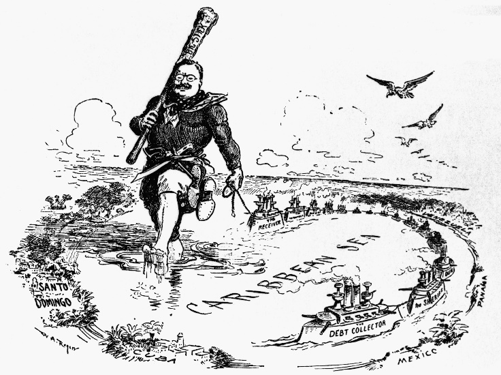
War is simply a reconciliation of relative bargaining power
“War is a continuation of politics by other means.” – Carl von Clausewitz
“The supreme art of war is to subdue the enemy without fighting.” – Sun Tzu

Recall that relative bargaining power determines surplus distribution in a voluntary agreement among parties. Typically, countries would issue an ultimatum before resorting to war, because war is incredibly expensive for all sides. Ideally, the adversary would recognize the threat-issuer’s superior bargaining power (ability to asymmetrically inflict unbearable costs/losses in the event of war) and grant concessions. However, if at least one side fundamentally misjudges the relative bargaining power dynamics by either overestimating their own power to inflict/endure losses or underestimating their adversary’s, they would seek a more maximalist position. That’s when war starts, and perceptions will reckon with reality.

When the bandits settle down
The threat of force is overt and visceral. When threatened with physical harm, people easily grasp the dangers they face and would more readily unite to confront a common foe. For example, if a group of bandits shows up at a village to extort the farmers for their harvests, the farmers might do something drastic. Seven Samurai is a famous Japanese movie about precisely this. However, if the bandits settle down, establish land ownership, they could become more than roving warlords. They needed a source of RBP beyond force.

Whereas the colonus system of the late Roman Empire served as the economic foundation of European feudalism (serfs tied to the land of a feudal estate), Charlemagne created the military hierarchy that sat on top of the economic model. As was the case throughout history when a powerful military society has largely conquered the settled peoples in reach, it must transform its existing extractive mechanism based on force (looting, plundering) or threat of force (demanding tribute or “protection” money) to something else. In the case of Charlemagne, he took the existing Roman colonus system and layered his military hierarchy on top, creating the archetypal European medieval feudalism, where vassals and knights pledge loyalty to their lords, who pledge loyalty to their own lords, all the way up to the king.

Bandits cannot feasibly run conquered territories by showing up every harvest season to demand tribute from peasants. The peasants might band together to fight back, hide their wealth, or just pack up and move. And risking the lives of peasants in a conflict means less surplus to extract next time around. It is much more expedient and stable to create political legitimacy and the administrative infrastructure for their extraction. Instead of forceful extortion, which would cause the people to forever view them as bandits, they become landowners and kings, who could tax and charge rent. Typically, the conquering warlords would co-opt the existing extraction mechanisms used by the prior elites and simply take over as new management, though often with a modified structure to suit their own contexts.

And so, the leverage of threat of force was converted into the leverage of control over critical resources (ownership of land).

Control of critical resources or assets
Controlling a critical resource or bottleneck massively increases bargaining power relative to almost all counterparties in the system. These bottlenecks can effectively hold the entire economy hostage and thus allow the extraction of commensurate surplus. Moreover, as the economy grows, the incumbent naturally captures a large portion of the increase in surplus as well, since relative bargaining power has not changed.
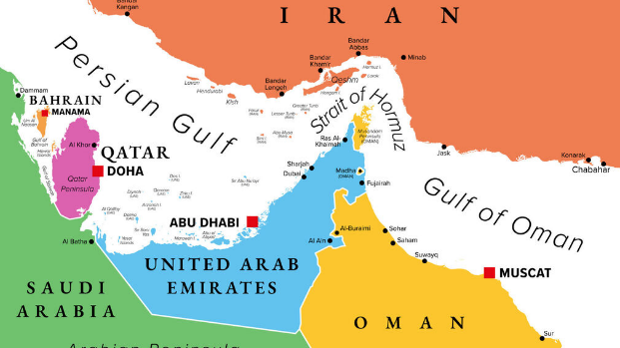
At the societal level, critical resources and assets include mineral rights (mines and oilfields), chokepoints (e.g. Strait of Hormuz), critical infrastructure (railroad, energy generation, water treatment, pipelines, etc.), key ports, land, etc. The control of a significant portion of any of these assets by a profit-seeking entity would result in surplus extraction at a societal scale, continuously taxing the local economy. It is no surprise that many of the most infamous oligarchs in the world derived their wealth from consolidating control over chokepoints in their nation’s economies. These people didn’t create value for society; they had extracted their wealth from the surpluses of their people.
- Robber Barons Rockefeller (oil refining and transport), Carnegie (steel), Vanderbilt (railroad)
- Russian oligarchs had bought Soviet state assets (oil, nickel, aluminum, pipelines, etc.) for dirt cheap, as part of the privatization drive of the neoliberal shock therapy after the fall of the USSR. These profit-seeking oligarchs took private ownership of massive state-owned monopolies
- Carlos Slim is the richest man in Mexico. When Mexico privatized its state-owned telecom monopoly, Slim led a consortium of investors to acquire it, and that became the source of his immense wealth, as he extracted heavily from Mexican society. Unsurprisingly, Mexico’s mobile telecom prices are among the highest in the world
- South Korean Chaebol oligarchs – Samsung is the prime example; the state had picked them as one of the engines of South Korean industrialization. Chaebols like Samsung hold overwhelming bargaining power vs the state, suppliers, domestic customers, and the South Korean people. Samsung dominates multiple key industries in SK, including electronics, semiconductors, construction, and heavy industries (shipbuilding)
- Adani of India – the Adani Group manages a huge portion of India’s ports (managing the largest port, Mundra) and is the largest private airport operator in India
- Suharto family (Suharto was the right-wing military dictator the US used to depose Sukarno, a left-wing revolutionary, nationalist, and first president of the nation of Indonesia) and associates were given monopoly positions on the trade of key commodities vital to the Indonesian economy
US dollar hegemony
Without going into too much detail, as this is a topic deserving of its own article, USD hegemony is the American Empire’s greatest leverage. Because the USD is accepted everywhere as the de facto currency of global trade (i.e. almost any international exporter is willing to accept USD as payment), for a small country to be stripped of its access to USD effectively places a blockade on that country without deploying a single warship.

Because USD can only be created by US commercial banks and almost all USD exists solely on US bank ledgers, the US government (via the US Treasury) can direct American banks to cut off certain individuals or states from access to the US banking system. Most devastating are secondary sanctions, where the US Treasury can cut off any foreign banks from processing transactions for sanctioned entities or risk being cut off from the USD system. For the vast majority of foreign banks, that is devastating – they will reluctantly comply. A person subject to secondary sanctions will find that they cannot access basic services for everyday life.

Unless the target is a large, economically powerful country that offers products that the world needs (like Russia offering oil, which can basically be used as currency), sanctions can completely hobble a country’s economic development and inflict immense suffering on the population (see Iran, Iraq, Cuba, etc.). A country like Cuba stands no chance – it has no oil to trade for manufactured products, and no counterparty is willing to accept Cuban pesos as payment. Without access to USD, Cuba must resort to bartering to get critical imports like oil; case in point, Cuba “exported” doctors to Venezuela in exchange for much-needed oil. A typical developing economy requires imported capital goods and equipment to rapidly industrialize, but if the German capital equipment vendor refuses to accept the local currency, what can the country do? Would the Germans take Cuban cigars and sugar as payment?

As a result of the US government’s exorbitant privilege of controlling the de facto currency of international trade, America holds extreme levels of bargaining power relative to most countries severally. That said, the more that the US abuses its financial dominance, the greater incentives other countries have to circumvent the USD system.
Control of land
One critical resource, land, holds particular importance throughout human history, because for the vast majority thereof, humans relied on the land for sustenance – agrarian economies simply could not do without vast amounts of arable land. To deprive/gatekeep land from people is to control their very livelihoods – as one can imagine, powerful landowning elites extracted commensurate surplus. This was the foundation of the power structure of agrarian feudalism, the basic political economy for the great majority of human history. Even today, everyone needs land to live on, even if modern economies don’t rely on agriculture.
Land is the most non-replicable, non-substitutable resource on earth. Particularly fertile or commercially useful land could easily become a tollbooth for economic activity, if held by private, profit-seeking parties. Simple ownership of important land will always confer high relative bargaining power because of the huge surplus created by that land for anyone who obtains the right to use it. For example, highly fertile land would yield lots of profits from agricultural production; desirable urban locations offer attractive quality of life and access to wealthy consumers and businesses.
In the US, old money dynasties in the Northeast were typically industrialists or financiers. In the South, they were typically plantation gentry. On the West Coast, however, old money was heavily based on land speculation. Ownership of land in strategic areas was the critical chokepoint upon which an extractive base could be built, especially as the Spanish and Mexicans were pushed aside (who had stolen land originally from the natives). Early settlers acquired vast tracts of land, often through Donation Land Claim Act (Oregon), Homestead Acts, or buying up Spanish and Mexican ranchos in California after Mexico ceded the western territories after their defeat in the Mexican-American War.
To boost the value of the land they had acquired, the settlers/investors heavily lobbied for their settlements to get railroad terminuses, universities, and other infrastructure, to ensure that their land became the city center. Once development arrived, their land values naturally appreciated, and the owners could harvest the surplus from other people’s economic activity via controlling the land. Anybody who wanted to participate in the economic opportunities in the developing area must pay their dues to the land speculators. In fact, already successful businessmen would buy up huge tracts of land before the 1900s to cement their wealth. The most notorious land speculators on the US west coast include:
- Seattle:
- Denny family – Arthur Denny was one of the founders of Seattle, as one of the first homesteaders to stake a claim in the center of later-to-be downtown Seattle in the 1850s (got 160 acres for free via homesteading). However, his family didn’t realize the land value until the 1890s, when Seattle really came into its own. Him and his initial settler group claimed large tracts of land along Seattle’s waterfront
- The Denny family provided the land for free to build Territorial University, later to become University of Washington, to increase land value
- Denny family – Arthur Denny was one of the founders of Seattle, as one of the first homesteaders to stake a claim in the center of later-to-be downtown Seattle in the 1850s (got 160 acres for free via homesteading). However, his family didn’t realize the land value until the 1890s, when Seattle really came into its own. Him and his initial settler group claimed large tracts of land along Seattle’s waterfront
- Portland:
- Several families including the Starks and the Ladds (William Ladd was the wealthiest person in the Northwest at the time of his death, heavily on account of his extensive land holdings). All of them were basically the aristocrats of Portland
- Oregon Land Donation Law of 1850 legally gave white men 320 acres for free, with their wives getting 320 acres as well. Those acres were halved for settlers coming after 1850.
- Several families including the Starks and the Ladds (William Ladd was the wealthiest person in the Northwest at the time of his death, heavily on account of his extensive land holdings). All of them were basically the aristocrats of Portland
- San Francisco:
- Miller & Lux dynasties – initially butchers in San Francisco, then cattlemen, Henry Miller and Charles Lux would eventually acquire over 1.25M acres of land across California, Nevada, Oregon, and Idaho. Miller is said to have owned more than 4.5M acres of land
- Pacific Live Stock Company infamously acquired thin strips of land adjacent to vital water sources, which allowed them to gatekeep the value of the surrounding lands, preventing water for herds and irrigation. This eventually forced small landowners to sell their land to PLSC for pennies on the dollar
- Phelan dynasty – James Phelan went to San Francisco after hearing about the discovery of gold in California. He initially made money doing typical merchant trading work but pivoted to real estate and finance in 1869. He had owned land in the financial district of San Francisco since the 1850s, so a big chunk of wealth came from that original ownership.
- Stanford dynasty – Leland Stanford, who owned >100K acres in California after a big buying spree in the 1880s and 1890s via his fortune in railroad
- Hearst dynasty – George Hearst made his fortunes on mines, then bought up 10s of thousands of acres between San Francisco and Los Angeles. His son expanded that to a maximum of 250K acres
- Miller & Lux dynasties – initially butchers in San Francisco, then cattlemen, Henry Miller and Charles Lux would eventually acquire over 1.25M acres of land across California, Nevada, Oregon, and Idaho. Miller is said to have owned more than 4.5M acres of land
- Los Angeles:
- Irvine dynasty – James Irvine acquired 93K acres from 3 massive ranchos, which is in today’s Orange County. The family has since donated most of the land to parks, but still retains around >30K acres of prime LA real estate; principal business is real estate
- Hellman dynasty – purchased ranchos that later became Long Beach and Seal Beach, Montebello, Boyle Heights, and a bunch of land near Lake Tahoe
It’s classic land speculation to acquire undeveloped land for cheap, then reap the rewards of natural land appreciation when development arrives. George Washington was a notorious land speculator. He involved himself deeply in the French and Indian War to stake land claims for himself. It’s no wonder that he fought for the independence cause – the future appreciation of his land holdings depended on American westward expansion. Following the French and Indian War, the British didn’t want to waste its resources fighting the Native Americans whose lands the colonists constantly encroached (since the British didn’t benefit from the encroachment), so they forbade colonists from settling west of the Appalachian Mountains via the Proclamation Line of 1763. Here are some choice facts about Washington’s land interests:
“Washington understood the potential of western lands from a young age. At seventeen, he received a surveyor's license from the College of William & Mary. His connections with the powerful Fairfax family helped him to become the official surveyor for Virginia’s Culpeper County. Soon he was surveying land west of the Blue Ridge Mountains, and making purchases as well. When he was only eighteen, Washington bought nearly 1,500 acres of land in the Shenandoah Valley.”

“Two of George Washington’s older brothers were partners in the Ohio Company, which hoped to obtain a massive grant of land in the Ohio country and then profit by selling it off in pieces. But the Virginians had to contend with the region’s Native inhabitants, as well as Britain’s great imperial rival, France.”
Source

“Over the next half century Washington would continue to seek out, purchase, patent, and eventually settle numerous properties. His will, executed in 1800, lists 52,194 acres to be sold or distributed in Virginia, Pennsylvania, Maryland, New York, Kentucky, and the Ohio Valley.”

“Washington's lifelong interest in land speculation is illustrated in the fight over bounty lands promised to the veterans of the Virginia Regiment who fought with him in the French and Indian War. In this episode Washington acted on behalf of his fellow veterans as well as vigorously, sometimes aggressively, in staking out his own land claims.”

Washington then paid a Pennsylvania surveyor William Crawford to ignore the Proclamation of 1763 and survey and patent land west of the Proclamation Line for himself, telling Crawford to use hunting as an alibi if he were caught surveying. Unsurprisingly, Washington claimed land that’s “the cream of the Country” for himself.
Source
Again, land is a finite resource with no substitute, so controlling key locations would naturally provide bargaining power relative to all counterparties and thus entitlement to substantial surplus extraction, typically via rent or sale price. Moreover, as land ownership consolidates, conditions worsen for everybody else, as competition lessens (thereby increasing relative bargaining power vs tenants) and surplus is further extracted.
In fact, many US downtowns are filled with decaying buildings because their owners are simply waiting for someone else to spend the money and take the risk to revitalize the area, such that they would capture the positive ripple effect in property values without lifting a finger. All they have to do is pay some nominal sum in property taxes, which are based on low assessed values (due to their own property being dilapidated), to sustain their ownership. They are themselves unwilling to spend the capital to develop their lots, so they hold hostage the development of those downtowns.
This dynamic is exactly why a self-taught economist Henry George became so famous around the world in the late 1800s – having seen firsthand the land speculation that plagued the West Coast, he was a vocal advocate for land to belong to the people and that there should just be a single tax on land. Singapore basically followed George’s ideas in the state ownership of almost all land in the city-state (not followed exactly but only in principle).
Reserves
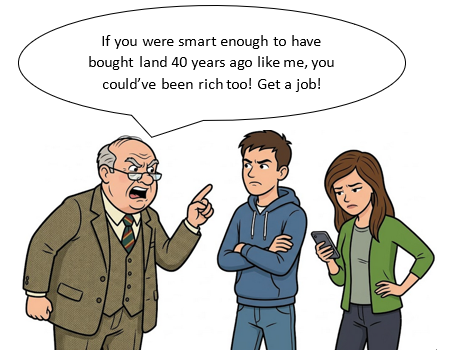
Reserves buffer desperation, which reduces RBP. Consider a union that has built up a substantial reserve of food and supplies before negotiating with company management. This allows the workers to outlast the company in the event of a strike, because the lack of work and wages would not immediately threaten survival. In contrast, if the company is substantially burdened by debt, it cannot sustain a work stoppage for long and would likely settle with the union in the workers’ favor. That said, a potential risk could be if a bigger company bails out the first company and could outlast the workers.
When negotiations break down, a strike occurs. A strike tests relative bargaining power – who folds first? It is well-documented that a strike was effectively a war of attrition between labor and capital; the side with more plentiful and secure reserves relative to consumption rates will most likely win and receive substantial concessions. However, both sides would ideally avoid a strike, since both sides expend resources in a confrontation. If a strike occurs, it is because one side overestimated their own or underestimated the counterparty’s bargaining power, and it would require both sides flexing their leverage to reconcile the difference.
Beyond labor relations, in general, those who have little in savings will find themselves in desperation when misfortune hits. The empirical evidence strongly supports this – the presence of a social safety net increases worker bargaining power and thus wages. There is a trade-off in that people would take longer to find the job that best suits their skills and pay expectations rather than immediately taking the first job, even if they are overqualified and underpaid. Generally, poor people tend to be more desperate when job hunting – they are likely to accept low-wage, low-security jobs rather than holding out for a better-paying, higher-quality one. Unsurprisingly, more business-friendly areas like southern American states tend to have weaker social safety nets, thus undermining worker bargaining power relative to employers and consequently tilting surplus capture in favor of employers. Moreover, American conservatives hate Medicaid and the ACA because weaker government healthcare for workers means that health coverage is gatekept by employment; undermining Medicaid and ACA increases worker desperation and employer bargaining power.
Workers vs the financial markets
In 2012, Hostess Brands (maker of Twinkies) was in bankruptcy, requesting deep cuts to wages and pensions, such that the Bakers Union initiated a nationwide strike. Negotiations failed, and the company was about to liquidate – instead, PE firms stepped in to buy the valuable assets like brands and recipes unburdened by prior union contracts, later restarting production with a non-union workforce.

In 2024, >33K machinists opportunistically went on strike in Boeing’s Seattle plants. At the time, Boeing was struggling financially due to production delays and repeated incidents on the Boeing 737 MAX. In response, Boeing raised $25B in stock and debt offerings as well as $10B in credit agreements with major lenders to shore up its reserves. Ultimately, the union achieved pay concessions – receiving 38% pay hike over 3 years instead of the original 25% over 4 years proposed by Boeing. Unfortunately, despite Boeing’s dire financial straits, the workers couldn’t obtain their ultimate prize of restoring their defined pension plans.

The greater the pools of liquidity in the capital markets, the larger the potential reserves available to company owners. In other words, highly “efficient” and “developed” financial markets structurally undermine worker bargaining power relative to capital. The owners of capital always have access to cheap sources of liquidity, whereas no such lifeline exists for striking workers. In a sense, workers in a modern, financialized economy compete against systemic liquidity. This way, the entire capital class engages in class solidarity, whereas workers lack such mechanism of mutual aid and unity.

Examples of liquidity sources available to the business owner:
•	Credit revolvers (banks)
•	Money market (retail and institutional capital)
•	Private lending (institutional capital)
•	Collateralized lending (banks and institutional capital)
•	Bonds (institutional capital)
•	Buyout (corporate and institutional capital)
Unity
“A chain is only as strong as its weakest link”
Proverb
It should come as no surprise that group unity greatly influences bargaining power. A united, cohesive group will always outperform a fragmented group pretending to be unified. An individual boycotting a company alone will never cause the company to change its behavior; however, a coordinated group of people simultaneously boycotting a company can effect change.
Inherent bargaining power advantage of capital vs labor
Unfortunately, capital typically holds structural bargaining power advantages over labor on account of unity. Whereas capital can easily consolidate and is perfectly fungible, labor is comprised of nonfungible humans with their heterogeneous beliefs and tribal instincts – workers are all too easy to distract and divide. Only state power (through antitrust enforcement) can prevent the tendency of capital to consolidate (cartels, M&A, price fixing, gentlemen’s agreements, etc.). In contrast, workers can be divided based on petty grievances or tribalism, citing superficial, immutable characteristics. American industrialists regularly used black laborers as strikebreakers, intentionally inflaming racial tensions among workers.

Workers cannot force each other to strike, but capital can even forcefully consolidate through hostile takeovers or coercion.
Prisoner’s dilemma is a classic game theory problem, whereby two prisoners are separately interrogated and are incentivized to betray each other. The game is structured such that no matter what the counterparty does, the superior option is always to betray them in a non-cooperative setting (when the prisoners are separated and the game is one single-round). Thus, the game almost always results in the players betraying each other. This occurs despite the fact that both parties would achieve a superior outcome by cooperating and staying silent. In theory, if two prisoners agree in advance to cooperate, they could overcome the dilemma and “beat” the incentives of the game. But it’s much harder in practice to stick to the plan, especially when one’s life is on the line.
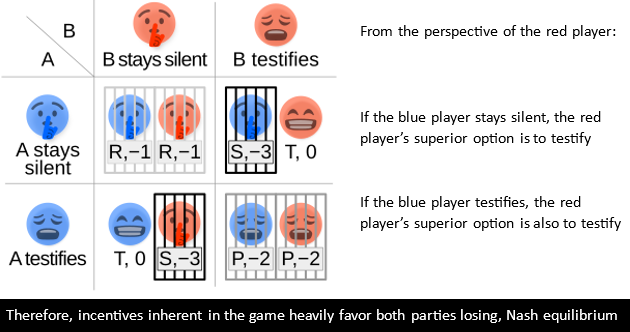
When it comes to unions, obviously, the more united the workforce behind the union’s collective bargaining efforts, the more powerful their leverage against company management and thus the more likely they will obtain concessions. The more employees join a strike, the less likely the company can continue operations and the more losses and opportunity cost the company will suffer. One factory suffering from a strike is painful but not debilitating. The entire production base striking is catastrophic. Companies would naturally try every tactic to break union cohesion – if they could convince workers that the union doesn’t represent their best interest or that the strike would fail and that they would lose their jobs, workers might abandon the picket line.
Massive union win
During the 1997 UPS strike, 185K Teamsters walked out, highlighting the incredible unity of the entire endeavor. Not only that, the UPS Pilots Union (a separate entity with 2K members) as well as hundreds of machinist union members joined the strike in solidarity, grounding the entire UPS air fleet so that the company couldn’t bypass the ground transportation stoppage with air transportation. The strike paralyzed the entire UPS operations, resulting in the company’s capitulation within 15 days. The union won massive concessions as a result.

Lack of alternatives
The virtues of capitalism are only achievable when there is sufficient competition (when RBP among counterparties is balanced), yet capitalists absolutely loathe competition. Historically, companies would try to eliminate competition by pricing rivals out of business in wars of attrition or through other aggressive tactics, then hiking prices. Rockefeller was infamous for doing this. Today, shareholders are much less amenable to those sorts of short-term pains; it’s more palatable to consolidate horizontally, i.e. buying up the competition to leave customers and suppliers with as few alternatives as possible. Additionally, a business wants to diversify or commoditize its counterparties, i.e. not be dependent on too few suppliers or customers, as a defensive measure against consolidated suppliers or customers.
Dysfunctional US healthcare system
Consider the chaotic US healthcare system – it is principally a bargaining power game between insurers and healthcare providers, as well as between pharmacy benefits managers (PBMs) and drug companies. Whoever can consolidate a large enough portion of the market relative to the counterparty wins.

In theory, the only reason health insurers and PBMs exist is to reduce healthcare costs for the sponsors of health insurance, including the US government, US states, and employers. Health insurers squeeze providers, and PBMs are supposed to squeeze the pharma companies but end up also squeezing, sponsors, pharmacies, and patients as well. As a reminder, health insurers create provider networks, where in-network providers agree to lower reimbursement prices in exchange for volume from the members of those health insurers. Similarly, PBMs create formularies (analogous to provider networks) for drugs wherein the drug manufacturers agree to lower prices in exchange for volume from the patients served by the PBM.

Health insurers have consolidated significantly over time, and their primary domain of competition is in local markets. After all, the patient is not going to travel to another town for healthcare services unless they have absolutely no options locally. Therefore, health insurers consolidated at the local level such that the healthcare providers have few alternatives and thus MUST give price concessions. The bigger the membership of the health insurer, the greater bargaining power they have vs the provider and the bigger the concessions they could demand. As a result, healthcare providers themselves were forced to consolidate; it became increasingly uneconomic to operate as independent physicians – the health insurers would squeeze them dry. Hospitals bought up each other and independent offices, so that they could equalize bargaining power vs the health insurers. As a provider, being shut out of a big membership pool of patients in the local market is catastrophic. As an insurer, having members shut out of the biggest health system in the local market is similarly disastrous. It devolved into an arms race of which counterparty could consolidate more in each local market. This is why we have massive, sprawling hospital systems and behemoth health insurers in the US today, a dynamic extensively documented.

PBMs have similarly consolidated over time, to increase bargaining power relative to the pharma companies. The more patients (demand) PBMs can gatekeep, the greater the opportunity cost they can impose on a pharma company by shutting them out of the formulary and denying them a big portion of their addressable market. However, because PBMs became consolidated middlemen, they have bargaining power over everybody in the entire value chain, not just the pharma companies. Is it a surprise that they also squeeze the sponsors (rebate capture), pharmacies (low reimbursement and encroachment), and even the patients (spread pricing)?

An astute reader might think, “that sounds like a compelling case for single-payer healthcare!” And he/she would be absolutely correct. The value these middlemen generate lies primarily in their relative bargaining power vs the vendors of healthcare products & services, and no vendor would have higher bargaining power than a monopsony. From there, the state-operated single-payer would be able to squeeze even more surplus value (only leaving some surplus to incentivize continued innovation rather than rent-seeking behavior) out of the sector on behalf of the people. Of course, the US could never pull off a proper single-payer system because the entire US government is thoroughly compromised by special interests.
The Chinese state leverages its immense bargaining power on behalf of the Chinese people and businesses, especially when leveling the playing field against powerful foreign oligopolies. One of China’s greatest advantages is its population and market size. Just like how the US gatekeeps its enormous consumer economy for favorable trade deals (e.g. the US frequently threatens tariffs on nations to force them to abide by DMCA, which is a US IP law, to protect US corporate interests), China gatekeeps its massive buying power to force concessions from Western companies, in the form of:
- Lower prices
- Yuan settlement
- Localized manufacturing, i.e. foreign direct investment
- JVs with Chinese companies
- Technology transfers
- Respecting Chinese geopolitical interests (e.g. the One China Policy)
Any Western company that refuses China’s terms would find themselves locked out of one of the biggest growth markets in the world with the largest industrial base and most comprehensive supply chains. That could lead to missed growth and profit targets for management teams and thus lower compensation and stock values. The cost of walking away is this: if one company refuses to share technology with China to access the market, their competitors won’t, leading to both forgone market share and technology – prisoner’s dilemma again! Sharing technology for market access is the Nash Equilibrium.
- “If my competitor chooses to share their technology, then I better share my technology too, since I would cede the entire Chinese market to them if I don’t.”
- “If my competitor refuses to share their technology, then I better share my technology, because I will gain Chinese market share at their expense.”
- “Also, if I give up my technology now, it won’t affect me anyways – dealing with rapidly advancing Chinese competitors will be my successor’s problem. Meanwhile, I get a massive payout for huge growth!”
China’s VBP in healthcare
China’s famous National Volume-Based Procurement program initiated in 2018 to consolidate bargaining power versus the vendors of healthcare products & services. The state (the Chinese public health system, which is basically the entire market) leveraged its overwhelming bargaining power to force price cuts, for the benefit of the Chinese people. The study I linked above found price cuts averaged >50%. Western firms were hit extra hard, as they charged premium pricing to begin with – medical devices had to cut prices by 80-90%. Moreover, China also has other programs targeting capital equipment like MRI scanners – the state has mandated centralized procurement and “Buy China” initiatives to force Western vendors of capital equipment to cut prices and localize production in China. This is in addition to the fact that Chinese radiography and radiotherapy companies are coming into their own, like United Imaging, threatening the comfortable oligopoly of GE Healthcare, Philips, and Siemens Healthineers.

Could this much pricing pressure disincentivize innovation? That’s definitely a possibility. The state would have to consider the trade-offs between savings and innovation funding, perhaps even using some of the savings to subsidize research.
China’s collective bargaining for steel mills
Another recent example is when China consolidated buying power of all its steel mills to force Australian mining giant BHP to accept 30% of its spot ore trades with China in RMB. Why BHP capitulated is easy to understand when contextualized with the fact that in aggregate, China produces 54% of the world’s steel output and imports 74% of all iron ore traded worldwide. BHP exported 295M tons of iron ore to China in 2024, and no other buyer could remotely absorb that level of demand. Historically, the big 4 mining giants (BHP, Rio Tinto, Vale, and Fortescue) had bargaining power advantage vs the many Chinese steel mills that bought individually. In 2022, China created China Mineral Resources Group (CMRG) to centralize buying, aggregating purchasing power. CMRG squeeze BHP hard by instructing mills to cease buying BHP iron ore on the spot market. This became an existential threat for BHP, which forced them to capitulate and agree to settle 30% of spot ore trades with China in RMB, undermining USD hegemony. Additionally, the USD-quoted prices had been based on indices in Singapore, and they’re now using Chinese domestic indices based in Shanghai and Dalian, which are lower than the ones from S&P Global’s Platts. While BHP learned their lesson only in 2025, the other 3 big mining giants had all already made concessions to China. Moreover, the Simandou project in Guinea is projected to come online in 2026, and it’s jointly owned/operated by China’s Baowu and Rio Tinto. Once operational, it will flood the Chinese market with abundant and very high-quality iron ore that’s partly Chinese owned, further increasing China’s bargaining power relative to all mining companies.
Commoditizing suppliers
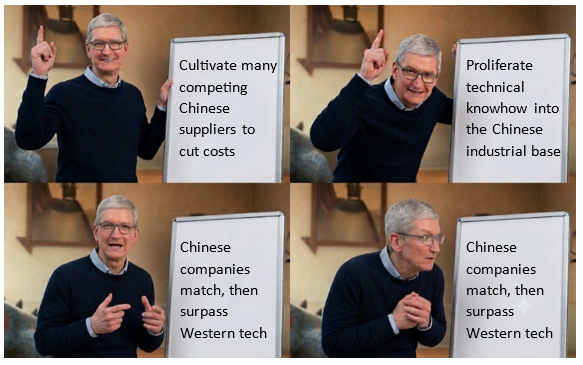
Apple under Tim Cook was famous for commoditizing suppliers to ensure Apple retains overwhelming bargaining power relative to all nodes in their supply chain. Apple took all necessary steps such that each vendor had competitors they could turn to if one vendor decides to get pushy. For example, Foxconn’s dominance as Apple’s key assembler was broken after Apple had incubated and groomed Luxshare Precision Industry as a capable rival, teaching them meticulously how to adhere to Apple’s exacting standards. Today, Apple plays the two companies against each other for the right to assemble various Apple products. Apple did the same thing to commoditize Samsung, whom they had used for years to build the OLED screens, charging premium pricing. Apple then took the time to groom a Chinese competitor BOE, a state-backed company, so that there’s an alternative to Samsung. As a result of all these supplier-commodification efforts, Apple captures >25% profit margins on the final retail price of their products, whereas Foxconn captures ~3% margin on the manufacturer sale price to Apple (much smaller denominator). Apple overwhelmingly captures the surplus within the entire value chain.

Of course, all of this played right into the hands of the Chinese state – in proliferating expertise into multiple Chinese companies, Apple created innumerable highly skilled hardware experts who would go on to supercharge R&D across the Chinese technology sector. Chinese engineers who work in Apple supply chains would be aggressively poached by companies seeking to replicate Apple’s hardware quality. Apple’s own suppliers end up lending their expertise to Chinese competitors to Apple like Huawei and Xiaomi. While Apple’s automobile ambitions died, Xiaomi transitioned from a smartphone manufacturer into an EV giant – the Xiaomi SU7 became a testament of Chinese EV dominance. BYD was originally an Apple battery supplier – it has since become an EV giant.
Information asymmetry
Information asymmetry occurs when one party has an information advantage over the counterparty. Typically, this imbalance dissipates over time, since the truth will generally come out. Today, the asymmetry can only persist and be abused at the consumer level rather than at the institutional level – think: state, corporate, etc.
A great example of this is when employees don’t know each other’s pay or the profitability of the company. The whole point of the pay taboo is to prevent underpaid employees from knowing that they have more bargaining power than they realize. Same goes for company margin – if the top-performing salesperson doesn’t know how much profit the company makes from each closed deal, he might not be aware of his true bargaining power. When companies aggressively hide their pricing information, they intend to maintain information asymmetry relative to their counterparties.
The fact that brands have any leverage over consumers also can be attributed to information asymmetry. For example, Tylenol can charge a premium price over generic acetaminophen, despite active ingredient being identical. Other brands can demand a premium price due to a luxury allure, even though the products cost a tiny fraction of the retail price. Of course, one can argue the luxury brands provide a social signaling value, but either way, this sort of bargaining power is only possible at the consumer level. No state would pay extra for social signaling (even if the sovereign might).
However, the most salient example is consumer price discrimination, enabled by information asymmetry, i.e. consumer data. While brands claim they only provide discounts to win over customers on the edge, it is merely an illusion, since the brand can simply recalibrate the base price higher than if they didn’t have consumer data in the first place, then claim to offer “discounts.” As Mark Zuckerberg works to gain greater access to people’s personal information, he will then monetize that data, which manifest in higher bargaining power (information asymmetry) for consumer brands to extract consumer surplus via first-degree price discrimination. In fact, companies would price gouge more desperate customers who have few options, resulting in sometimes lower prices for wealthier people. In other words, consumer privacy protects the people’s bargaining power from severe information asymmetry.
Broad form deeds
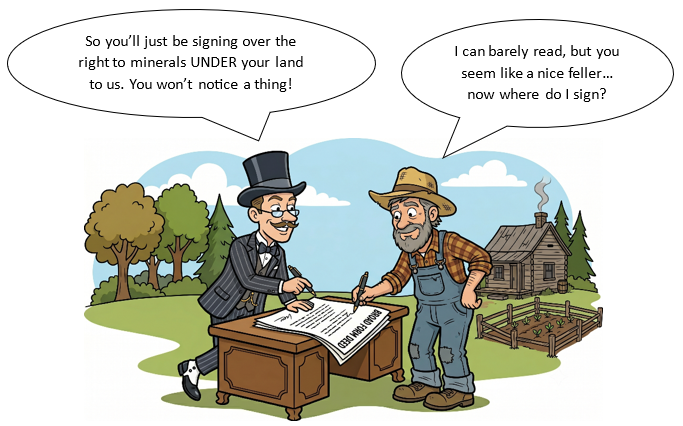
Historically, wealthy, literate elites would often take advantage of the poor’s illiteracy or legal naivete to deprive them of their land or resources. One of the more egregious examples was the broad form deeds used by mining companies operating in Appalachia. Their agents, called “landmen” would travel through the impoverished regions of Kentucky and West Virginia to buy up mineral rights from local landowners for de minimis sums. The companies would acquire the mineral estate, while the landowner would retain the rights to the surface estate. The deed granted the mineral owner rights including the construction of anything necessary for mining purposes, like buildings, transportation lines, and diversion of waterways to access the minerals. Of course, the actual operations required to access the minerals would frequently disrupt farming operations and life on the land surface.

Later, courts (Buchanan v Watson, 1956) would uphold the privileges of the mining companies, such that strip mining would be allowed to access the minerals under the surface, regardless of how much it impacted the interests of the surface owner.

The landowners who sold their mineral rights could hardly have been expected to understand the legal nuances of granting mineral rights to mining companies, much less potential technological advances that would enable strip mining.
Disruptive technologies
This is quite straightforward – new technologies can fundamentally shift relative bargaining power between counterparties by, for example, bypassing chokepoints. There are endless examples thereof, so I will list a few here:
- The adoption of gunpowder weapons fundamentally changed the power dynamics between the landed gentry and the crown by obviating basic fortifications
- The power loom rendering manual weavers obsolete, destroying the entire trade
- Once trains and railroads were invented, canals were rendered obsolete
- Kodak and the digital camera, ending Kodak’s comfortable market position selling film
- Renewable energy bypasses the hydrocarbon chokepoint for development; petrostates increasingly worry about relying on hydrocarbon exports as the foundation for their economies. It also threatens the petrodollar chokepoint for American financial hegemony
Competitive moats
Anyone who’s ever delved into the world of investing in businesses has probably heard of the term “economic moats,” which are sources of competitive advantages enabling a business to sustainably earn high margins and returns on capital. In reality, it is merely structural bargaining power advantage relative to customers and suppliers.
Switching cost
Switching cost, i.e. the cost or opportunity cost of walking away from a vendor, is just one form of relative bargaining power. Vendors (especially software companies) would often impose long-duration contracts with high buyout penalties, proprietary software or hardware to limit interoperability, and bundling of products & services; these features inflict high cost of walking away onto the customer, enabling commensurate surplus capture.
Gatekeeping demand
Because certain companies have achieved gatekeeping of demand – ensuring that end-customers go to them first when looking to buy – they wield significant bargaining power advantage relative to all other parties in the value chain. Google and Amazon are two of the largest demand aggregators in the technology space, such that people would search their websites for products they want to buy. As a result, any supplier who refuses to pay Google or Amazon for search-priority finds their products invisible to customers.
Network effect
Network effect is when customer value is derived from the size of the customer base – the more users there are on a platform, the more valuable it is. Social media is the classic example of network effect, wherein anybody who refuses to join the network loses out on content posted by their network on the platform. While social media doesn’t explicitly charge fees for use, users pay via their attention and time, monetized by ads and consumer data (information asymmetry). Over time, social media experiences degrade due to increased proliferation of ads and data tracking.
Oligopoly + high barriers to entry
Companies competing in oligopolistic industries that benefit from high barriers to entry ensure that customers have few alternatives. For example, industries that are capital-intensive tend to be bereft of new entrants, as investors are typically loath to provide capital for those industries. This is simply an expression of high RTWAC due to the lack of competition.
Technological advantage
Companies that own patents for advanced products can gatekeep the value they create for customers, since intellectual property laws inhibit competition from replicating the same value. Novel pharmaceuticals are the best example. Consequently, these companies possess high relative bargaining power.
Cost advantage
Even an economic moat derived from cost advantage still depends on relative bargaining power to generate high margin and returns on capital, though less overt than the aforementioned sources of moat.
Progressive
Progressive’s business model relies on superior underwriting and direct distribution to reduce cost for policyholders. The company can price risks more accurately than competitors, allowing them to offer lower-cost policies for safe drivers, capture market share, and enjoy high margins and returns on capital relative to competitors.
If Progressive can achieve $100 of cost advantage per customer per month relative to competing insurers, they may pass along $40 of savings to the customer via lower premiums but keep the other $60 as excess profits. This allows them to win market share from rivals and generate superior margins and returns. Naturally, the $60 in excess profits can only be captured due to Progressive’s unique cost advantage.
Walmart
While Walmart benefits from economies of scale, the company relies heavily on bargaining power vs suppliers – Walmart is infamous for squeezing suppliers via massive buyer bargaining power. As a result, suppliers barely make much profit on the Walmart account and thus are forced to raise prices on Walmart competitors, like mom & pop grocery stores.
Lack of sovereignty supersedes RBP
Recall I had said in Incumbency Theory 1.1 that there’s one exception to the rule that relative bargaining power determines surplus distribution in the long-run. Lack of sovereignty neutralizes RBP in the context of the agency problem, wherein the agent acts in their own best interests instead of the interests of the principal. In that sense, the principal, due to having a compromised agent, has no sovereignty.
As I had discussed earlier regarding CMS regulating the healthcare sector, the American people have lost their sovereignty, because their agent, CMS, ceased to represent their interests and instead prioritizes the profits of special interest groups. Any counterparty negotiating with CMS (which in theory is equivalent to negotiating with the American people) has a massive advantage because the counterparty has no sovereignty.
Ideally, the state should hold overwhelming bargaining power within a country, leveraged for the benefit of the people rather than for extraction, since the state and the people have an agent/principal relationship rather than an economic relationship. However, all the bargaining power in the world means nothing if the agent is compromised!
Compromised regulator
As discussed earlier, in theory, CMS has overwhelming bargaining power over the health insurers, but it never squeezes its contractors as much as it should. In general, the government contracting entity (CMS, in this case) should be extremely demanding when it comes to the binding terms the contractors (the health insurers) must follow, because it usually has monopsony power. Unfortunately, the system is corrupt to the very core, as health insurers and other healthcare companies hire ex-heads of CMS to lead their lobbying efforts. The flow goes the other way as well, with industry executives becoming the regulator – a wolf becoming the watchdog. Who knows how to find loopholes in the law better than the very people who used to lead the enforcement agency? Below are some examples:

(1) Marilyn Tavenner, the head of CMS under President Obama in 2013-2015, oversaw the rollout of ACA exchanges. She was hired to lead the health insurer industry’s top lobbying group AHIP a few months after resigning from CMS

(2) Tom Scully, the head of CMS under President Bush in 2001 to 2004, was the key architect for the Medicare Modernization Act of 2003, which privatized huge portions of Medicare and basically created the money machine that’s Medicare Advantage (Medicare plans administered by insurance companies). He immediately went on to join Alston & Bird, a major lobbying company for pharma and hospital clients and later became a partner at a private equity firm specializing in buyouts of healthcare companies

(3) Andy Slavitt served as head of CMS from 2015-2017, and he was previously a top executive at Optum, a subsidiary of UnitedHealth
Wrapping up 1.2
In Incumbency Theory 1.1, I defined relative bargaining power and provided the theoretical foundations thereof. RBP is the foundation of microeconomics, which economic dogma today fails to appreciate.
In this article, I provided many sources of relative bargaining power as examples of how it manifests in practical applications. The elites are acutely aware of bargaining power intuitively, but the people fail to understand its implications.
In Incumbency Theory 1.3, I will point out how Marxist and liberal economic orthodoxies fail to contextualize their theory in the framework of relative bargaining power and thus fail to achieve the desired outcomes. I will also explore in depth how to apply RBP on a systemic basis rather than just on a 1:1 counterparty basis.
1 thought on “Incumbency Theory 1.2: Sources of Bargaining Power”