In this article, I will show how certain human natures are directly the result of selective pressures – vestiges of our evolutionary past manifest in behaviors that often undermine civilizational needs. Specifically of interest to me is the conflict between self-interest and group interest, so intrinsic to the human condition: what factors cause people to sometimes favor themselves over the needs of the group and vice versa? Conclusions derived here will segue into future analyses and extrapolations into modern human behavior, particularly those of the elites, i.e. people wielding great wealth and power.
An astute reader will notice significant overlap between my thesis and Marx’s historical materialist theory on how the advent of agriculture created the conditions for institutionalized oppression and exploitation of the masses for the benefit of the elites, whereas it had previously been impossible. The reader might also notice the similarity to Gerhard Lenski’s 1966 book Power and Privilege, the central thesis of which argued that surplus (resources or productivity above subsistence) created social stratification, and technology (agriculture and animal husbandry) created structural achievable surplus in human society. In this article, I overlay an evolutionary game theory context to Marx’s political and Lenski’s sociological theories.
Thesis overview
This is the chain of logic I will use to make my arguments:
- Humans are inherently social animals; in hunter-gatherer tribes, survival mandates cooperation, selecting for pro-social virtues
- In stable environments, hunter-gatherer tribes typically live at reproductive subsistence, i.e. they can gather just enough resources to survive and reproduce at a replacement level
- Reproduction is a zero-sum game, incentivizing competition, though not inherently competitive
- All human anti-social vices originate from our reproductive drive, which pushes us to maximize reproductive opportunities in a zero-sum game
- However, for hunter-gatherers, survival considerations supersede competitive incentives inherent in reproduction, resulting in collusive reproduction, i.e. monogamy
- Oppression and significant inequality are impossible under reproductive subsistence at the societal level; only possible when society can achieve growth surplus
- Polygyny (hoarding female mates) requires significant social inequality (relative abundance) and societal growth surplus (absolute abundance)
- Agriculture and animal husbandry sustainably create growth surplus at the societal level (absolute abundance), which also allows for oppression and significant structural social inequality (relative abundance for the elites)
- Thus, by (6), (7), and (8), agriculture and animal husbandry created the conditions for social inequality, whereby elites extract societal surplus and thus practice polygyny
- Beyond sufficient resources for survival subsistence (5), people principally care about relative fitness (resources, prestige, political power, etc.), since that’s what matters for reproduction
- Hijacking the evolutionary game theory that incentivizes maximal reproduction (maximizing relative abundance), elites endlessly accumulate far beyond what could be rationally justified, causing tremendous suffering within and without their own exploited base
Zero-sum vs cooperative games
Here’s a quick refresher on game theory:
- A zero-sum game is a scenario where the total spoils are fixed regardless of players’ behavior, merely distributed among them. Any losses incurred by one equates to gains by another; only relative competitiveness matters. Thus, a zero-sum game is typically competitive, as sabotaging others improves one’s rewards.
- The only alternative to competition is collusion, where players agree to split/share a resource rather than competing aggressively to maximize their own share. Collusion happens when direct competition is too costly or risky
- A cooperative game is a scenario where the total spoils depend on player actions. When players cooperate, everybody wins. Thus, in a cooperative game, players will exhibit pro-social behavior – incurring costs or taking risks for the benefit of the group or another player.
- Sometimes, players may be incentivized to cheat in a cooperative game to obtain outsized rewards for minimal effort or risk – basically a free rider problem. Free riders are much more likely to arise and harder to detect as group size increases and margin of error/waste increases
Biological incentives
Recall that the only objective of life is to produce viable offspring to perpetuate one’s genetic code. Time will filter out all those that fail to achieve this singular objective. As a result, the only surviving organisms will be well-adapted to 1) survival and 2) reproduction of viable offspring, provided survival; I divide that central goal into two sub-objectives because each involves a separate game for the human species.
Before that, let’s first define a few key concepts, specifically in the human context.
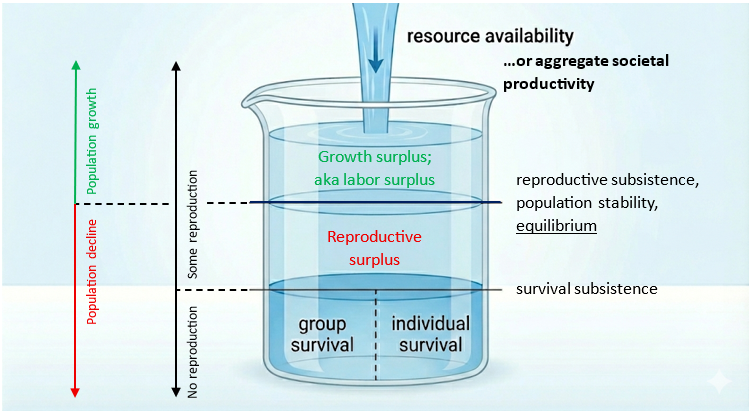
In a given population, resource availability (or after the discovery of agriculture and animal husbandry, “resource productivity,” as those methods allow humans to produce their own food rather than procure it from available sources in the environment) determines the maximum supportable population in an ecological context. If resources are below what is needed to maintain the survival needs and replacement reproduction needs of the population, then naturally, population declines. Of course, a smaller population means that less resources would be needed to sustain it. Over time, population adjusts to reach equilibrium relative to available resources; if resources exceed population needs, then population would grow until it reaches equilibrium.
For hunter-gatherers, individual survival is contingent on group survival – the tribe lives or dies together. If some of the hunters in the tribe get injured, the entire tribe’s survival is threatened. Those injured must be fed and taken care of so that they can recover. When pro-social virtues shine brightest even in the darkest depths of deprivation, when those who have so little to give still lend a hand to strangers or those less fortunate, know that it is a manifestation of hunter-gatherer ethos.
I define the following terms as such:
- “Equilibrium” – when resource availability matches what the population needs to maintain itself, ensuring a stable population over time
- “Survival subsistence” – the level of resources such that the population has just enough to feed itself, but not enough to expend on any reproduction
- The difference between resource availability and survival subsistence…
- “Resource surplus” if the difference is positive (some reproduction)
- “Resource deficit” if the difference is negative (no reproduction)
- Resource surplus is the sum of “reproductive surplus” and “growth surplus”
- “Reproductive surplus” is any resource surplus above survival subsistence, but below equilibrium
- “Growth surplus” is any resource surplus above equilibrium level, leading to population growth. This is the most important term to remember here.
- NOTE that this becomes “labor surplus” in a Marxist/labor context when applied to the average worker, because people’s labor produces resources. Labor surplus is any productivity of the average worker above and beyond what’s needed to keep them alive and reproducing at replacement level
Survival – a cooperative game for humans
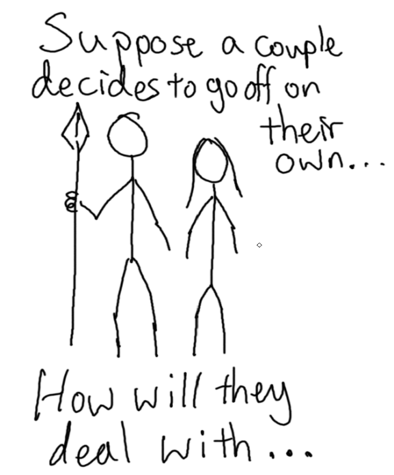
Humans evolved from apes and are inherently social animals for survival purposes. Humans are quite physically weak compared to animals of similar or larger size – especially predators. Our core edge is intelligence, social skill, and dexterity, which enable the use of tools and strategies to compensate for physical deficiencies. Group cooperation is critical; an outcast perishes quickly, which is why our nervous systems evolved a powerful aversion (in the form of fear and anxiety of being disliked) to social isolation. Due to a cooperative survival game, time and evolution have heavily favored pro-social dispositions in humans.
The earliest form of human social groups is hunter-gatherer tribes, which are somewhat comparable to the social groups of our primate ancestors, but augmented by superior intelligence, which feeds into greater and more complex social skills, especially language. Humans can reason and communicate in a much more sophisticated manner than other primates, allowing cooperation otherwise inaccessible to more primitive social animals. Hunting mammoths best exemplified the superiority of human cooperation over that of our pre-human ancestors.
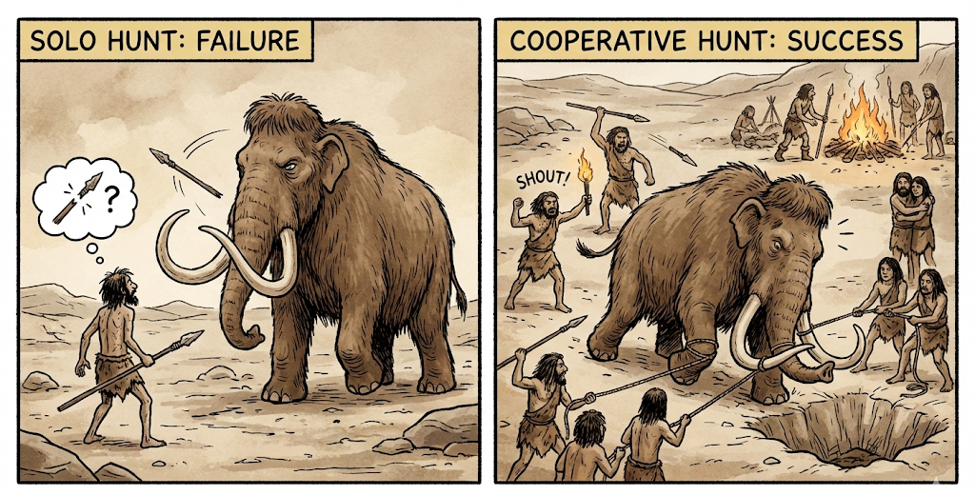
Without question, cooperation was indispensable to hunter-gatherer life, but ultimately, life was still at a reproductive subsistence level, i.e. there wasn’t much room for non-survival/reproduction-related activities. The margin for survival was slim – a few key hunters getting injured or killed or migration into a resource-poor area could result in death of the tribe. In other words, the tribe generally could procure just enough food and resources to sustain itself and propagate the next generation, net of attrition from infant mortality, disease, etc. This was typically the case for non-human animals, because if there were insufficient resources, the population would decline until the population/resource balance reached an equilibrium (subsistence). Conversely, if there were an abundance of resources or territory, the population would boom until reaching equilibrium (subsistence); though, depending on how sustainable the abundance (growth surplus), human societies could develop early signs of social inequality, as I will discuss later. As a result of the perpetual state of subsistence, individuals made sacrifices for the good of the group, and the group made sacrifices for individuals.
Specifically, what benefits did living in tribes confer on early humans?
- Better economics
- Division of labor/specialization
- Sharing of knowledge passed across families and generations
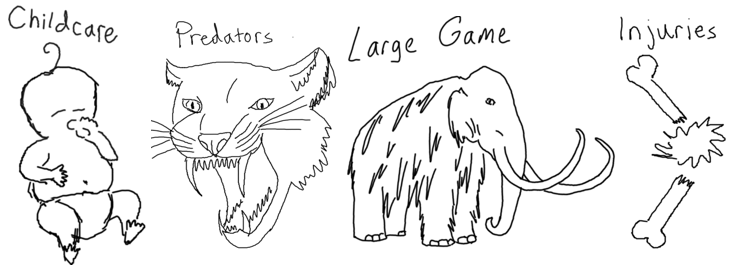
- Ability to hunt larger prey
- Communal childcare – human children require some of the highest caregiving investment compared to other animals
- Diversification of sources of food and water (e.g. a bad day of hunting for one person can be offset if someone else had a good day)
- Better security
- Defense against competing tribes – just the presence of a large tribe is often sufficient to deter potential aggressors
- Defense against predatory fauna
- Lower risk of death from injury, illness, drowning, and other catastrophes
Intertribal relations
During Paleolithic (pre-agriculture), conflict between tribes occurred, but not as a matter of policy (there were a few exceptions in unique environmental conditions). Intertribal relations were sometimes zero-sum (because territory/resources were inherently limited) but very often cooperative – some tribes established “insurance/diversification” networks whereby if one tribe had a string of hunting failures, another nearby would offer them some food surplus. It was understood that the favor would be returned later. There was also the dynamic of genetic diversity – marrying outside one’s tribe, which meant that neighboring tribes often shared blood relations to some extent. In terms of conflict, violence is extremely costly and thus risky for all sides; the victor must thereafter defend their hard-won new territory from a counterattack or a wholly different tribe seeking to capitalize on their weakened state. There wasn’t much to loot anyways – the assets required work to be exploited to have any value (berries gathered, game hunted). Unless a tribe was forced to migrate/encroach into another tribe’s territory due to deteriorating conditions in their own territory, there weren’t many incentives to fight.
Humans’ ability to empathize with non-family members was indispensable for cooperation within the hunter-gatherer tribe – humans have a much greater propensity to allow non-family members into their tribes compared to other primates with less sophisticated social structures. I believe the vast majority of what people typically consider “good” traits are simply pro-social traits developed out of necessity of maintaining group cohesion within these hunter-gatherer societies. Examples include selflessness, generosity, compassion, loyalty, platonic love, and a sense of fairness/justice. If one member of the tribe was observed displaying hoarding and overly selfish behavior, like refusing to share the kill, to the detriment of others (since there wasn’t that much to go around to begin with), the group had the incentive to punish that member, as failing to do so would embolden them to push their luck, possibly even inspiring others to follow in their bad example. That would, over time, lead towards deterioration of group cohesion.
The writings of anthropologists make it clear that hunter-gatherers were not passively egalitarian; they actively so. Indeed, in the words of anthropologist Richard Lee, they were fiercely egalitarian. They would not tolerate anyone’s boasting, or putting on airs, or trying to lord it over others. Their first line of defense was ridicule. If anyone—especially some young man—attempted to act better than others or failed to show proper humility in daily life, the rest of the group, especially the elders, would make fun of that person until proper humility was shown. […]

On the basis of such observations, Christopher Boehm proposed the theory that hunter-gatherers maintained equality through a practice that he labeled reverse dominance. In a standard dominance hierarchy—as can be seen in all of our ape relatives (yes, even in bonobos)— a few individuals dominate the many. In a system of reverse dominance, however, the many act in unison to deflate the ego of anyone who tries, even in an incipient way, to dominate them.

According to Boehm, hunter-gatherers are continuously vigilant to transgressions against the egalitarian ethos. Someone who boasts, or fails to share, or in any way seems to think that he (or she, but usually it's a he) is better than others is put in his place through teasing, which stops once the person stops the offensive behavior. If teasing doesn't work, the next step is shunning. The band acts as if the offending person doesn't exist. That almost always works. Imagine what it is like to be completely ignored by the very people on whom your life depends. No human being can live for long alone. The person either comes around, or he moves away and joins another band, where he'd better shape up or the same thing will happen again. In his 1999 book, Hierarchy in the Forest, Boehm presents very compelling evidence for his reverse dominance theory.
Source
Of course, that pro-social instinct cannot extend universally – it generally was confined within one’s own tribe, which is entirely a social construct, even today. Despite regular cooperation with neighboring tribes, one still had to first look out for one’s own first and foremost. Consequently, while humans have evolved strong pro-social tendencies, we are also highly tribal, emphasizing loyalty to one’s tribe and competition towards rival tribes. For there to be “us,” there also must be “them.” For there to be a strong group identity, so too must there also be exclusionary elements. The instinct towards tribal loyalties can be incredibly strong, manifesting in the modern day as loyalty to one’s sports team… or one’s own country. This is a compelling evolutionary basis for nationalism, which is, in my view, the most powerful ideology to have ever existed, but I will expand on this topic in future articles.
Humans spent the overwhelming majority of our evolutionary past in these hunter-gatherer tribes (~200K years prior to the advent of agriculture about 10K years ago), so I can convincingly argue that pro-social behavior is intrinsic to humanity.
An exception – sudden resource scarcity
I’m sure we’ve all seen or read catastrophe media, like zombie or extreme weather apocalypse or even artificial environments like Squid Games or Battle Royale, where the message is that humans are capable of great cruelty and anti-social behavior in desperation. One’s polite neighbor may not be so polite if he has to kill to feed his family. Indeed, when resources become suddenly scarce, the situation devolves into a zero-sum, competitive game, where it is no longer beneficial to cooperate and act in a pro-social manner. However, that would require a rapid shift in the environment to massively reduce the amount of available resources such that the population doubts the remaining quantities are immediately sufficient for all. That doesn’t typically happen unless society collapses or there’s an extreme weather event (e.g. Bronze Age collapse).

When Nietzsche said, “what is evil? – whatever springs from weakness,” he was referring precisely to this phenomenon, where people in desperate zero-sum games resort to whatever means to get ahead. Extreme scarcity demands behaviors typically considered immoral; after all, the well-to-do don’t need to lie, cheat, steal, backstab, etc. to survive. The aristocrat can afford to be generous, whereas the generous tenant farmer might not make it through the winter.

If humans are pro-social in the vast majority of circumstances, then it is only fair to say that humans are pro-social by nature. The same way one would say that grass is green, despite the fact that grass yellows in the late-autumn and winter.
With all that being said, it’s equally obvious that humans are also capable of extremely anti-social, competitive behavior more aligned with a zero-sum game – it’s because of reproduction. I will argue that without the need for reproduction, there would be very little need for traits considered anti-social like selfishness, schadenfreude, greed, cruelty, envy, elitism (any behaviors associated with hierarchy fetishization), etc.
Reproduction – the quintessential zero-sum game
Sexual reproduction is purely a zero-sum game and thus typically, though not necessarily, competitive for animals. There are only a set number of the opposite sex and thus limited number of reproductive opportunities, and individuals of one sex must compete amongst each other for reproductive access to the most fit members of the other sex, i.e. the members who will grant their offspring the best chance at survival to adulthood and thereafter, further propagation. In reproduction, one can gain if and only if another one of the same sex loses; no amount of cooperation can increase the total number of reproductive opportunities for all individuals in a system.
Let’s examine one of nature’s most peculiar examples of reproductive dynamics – the elephant seal. Typically, a dominant male elephant seal will hoard a large number of female sexual partners and will aggressively defend his harem, thus maximizing the propagation of his genetics. Consequently, most male elephant seals will not be able to reproduce in any given mating season. However, there’s also the phenomenon of the beta bull elephant seal – not quite as strong as the alpha male, but strong enough to help the alpha male chase off other males and preventing them from mating with the harem. In return, the beta bull may opportunistically mate with a female in the alpha’s harem when the alpha is otherwise preoccupied. We can make the following observations and note additional facts:
- Elephant seals do not need to cooperate to survive – they are solitary hunters; thus, social considerations do not factor into their calculus when it comes to breeding
- Alpha bulls assert their superiority to capture as many females as they can defend from competitors, thus maximizing their ability to propagate their genes – time and natural selection reward this behavior
- Beta bulls follow a different strategy – instead of being relegated to having 0 opportunities to reproduce by fighting the alpha bull, he chooses instead to collude with the incumbent to maximize the chance he will reproduce at all
- Real fights are rare because of cost and risk; displays of strength and dominance usually suffice to scare off rivals rather than resorting to violence and risking injury
- Risking violent confrontation with the alpha and betas could just benefit the non-combatants, who would swoop in and reap the spoils! This is a zero-sum game, after all. Consequently, there is little incentive to violently disrupt the harem
- Violence against the alpha and beta seals is highly risky because seals fight in close quarters, where sheer strength wins. If seals could use throwing weapons, however, then the alphas and betas could be easily dispatched by the masses, with minimal risk to oneself… potentially resulting in a more egalitarian distribution of mating opportunities

The calculus differs for humans – hunter-gatherers have been typically monogamous. It is certainly possible that a great hunter could justify two wives, but hoarding so many wives as to deprive fellow tribesmen of mating opportunities altogether would be impossible in a subsistence context. If one male tried it, tribal cohesion instantly breaks down. The deprived males could simply refuse to hunt with the hoarder or attempt to kill him in his sleep (both of which would threaten the survival of the hoarder) – social factors greatly reduce the possibility of polygyny. What have we just concluded? Due to the need for group cohesion (a necessary condition for group survival) superseding the biological pressure to maximally spread one’s genetics, humans collude in reproduction, despite the fact that it is a zero-sum game. This results in monogamy.
There are other animals with a similar calculus, often resulting in serial monogamy, lifelong monogamy, or social cooperation in raising their young. These other species have comparable pressures that also supersede competitive reproduction (esp fighting peers for mating opportunities). One example is high parental investment (humans also have this trait) – lengthy gestation, extended care, protection from predators, where both parents are needed to maximize the survival probability of their offspring.
Birds are highly monogamous; >90% of bird species have some form of monogamy. Some form lifelong pair bonds (e.g. geese), while others are serially monogamous, changing partners every mating season (e.g. emperor penguins). This is due to the high level of parental investment needed to successfully raise their young to become independent, including nestbuilding, incubation, defense, feeding, etc. Chicks/eggs die without both parents contributing to its survival, so deadbeat dads would fail to successfully pass on their genes. Birds lay vulnerable eggs, and their young are also completely defenseless before they can fly. In contrast, the vast majority of mammals aren’t monogamous (exceptions include wolves), because their young are nourished through gestation internally (carried with them instead of hatched from vulnerable eggs) and also via nursing after birth, rendering males less essential for survival of the offspring (bears are a great example). Animals that rely on sheer numbers to ensure offspring survival (fish, amphibians, insects, etc.) rarely have monogamy.
While humans, in our hunter-gatherer stage, were incentivized to monogamy, it is more of a social construct in response to a very real survival constraint rather than biological instinct. Humans are very capable and willing to be polygynous when the opportunity presents itself. Insofar as survival demands group harmony, monogamy wins out. What conditions allow for the possibility of sustainable human polygyny? Absolute and relative abundance – these conditions break the link between social cohesion and group survival, i.e. individuals no longer hold substantial leverage on the survival of the group.
- Relative abundance at the individual level (i.e. relative abundance) – because reproduction is a zero-sum game, one would need to accumulate more relative resources than the average competitor to attract and defend more than 1 mate, especially as child-raising is taxing and time-consuming for humans. In other words, it requires significant social inequality.
- However, this isn’t possible without…
- Potential for sustainable growth surplus (i.e. absolute abundance) at the societal level
- This means the exploited class, e.g. farmers, laborers, etc., would have to generate a growth surplus that can be extracted by the hoarders (elites)
- Within reproductive subsistence society like hunter-gatherer tribes, achieving sufficient inequality would seriously deprive resources from other members of the tribe, risking their death and thus the survival of the tribe
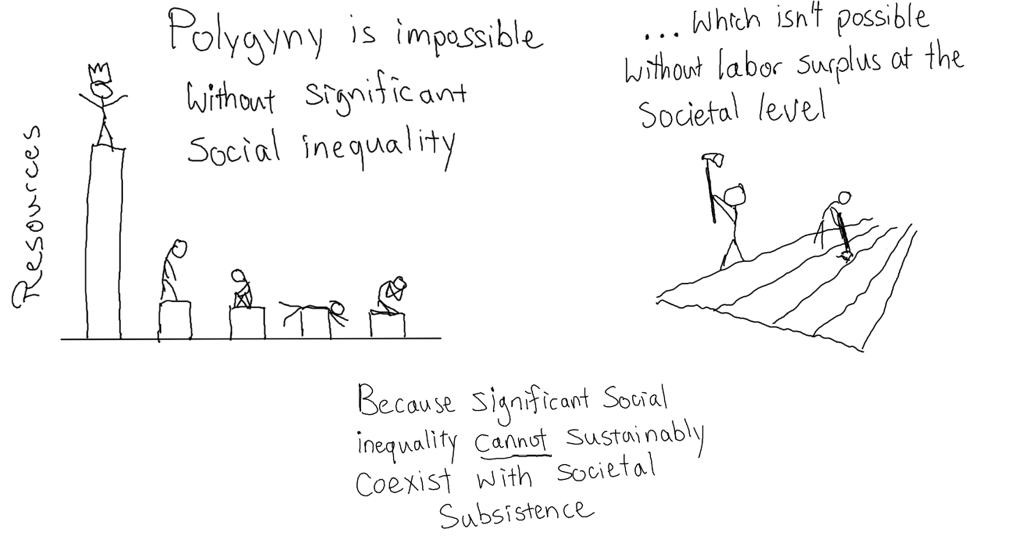
We have thus found the core reason for the human instinct to accumulate/hoard as much resources as possible in an abundant environment – reproduction. Humanity’s worst anti-social traits and behaviors originate from the capacity of every human to reproduce, especially with males bearing minimal cost and risk in each copulation – traits & behaviors like sabotaging peers, backstabbing, extractive greed, envy, pettiness, treachery, selfishness, arrogance, cruelty, etc. Especially Schadenfreude, which means the joy derived from someone else’s misfortune (implying an improvement to one’s own lot in a zero-sum game) – it’s no surprise that Schadenfreude occurs more when the person failing is of the same sex as the observer, as reproduction is the quintessential zero-sum game. Without the capacity to reproduce, humans would have very little incentive for anti-social behaviors. Let’s look at what happens when the vast majority of a social animal is incapable of reproduction.
In biology, “eusociality” refers to the highest level of social cooperation within a social animal group; examples include ants, bees, and naked mole rats. This means that members of that group only live to perpetuate the survival of the group (really the monopolist breeder, the queen) and thus have effectively no self-interest. All of their resource surplus (anything beyond what they need to survive and perform their job) is expended for the colony. It doesn’t mean the non-reproducing members of the group have no self-preservation instinct but rather that they would readily give their lives for the benefit of the colony. Based on our analysis above, it should come as no surprise that the vast majority of the animals in eusocial species are reproductively suppressed either physiologically or sociologically, typically by the monopolist breeder, i.e. the queen, via pheromones. In fact, the reproductively active members (both male and female) will aggressively crush potential challengers to their monopolies – this is a zero-sum game, after all. The worker members (non-reproductive) of eusocial colonies are incapable of playing the zero-sum reproduction game and thus are 100% pro-social.
Unsurprisingly, when the workers recover their reproductive ability (e.g. via the loss of the queen and thus the cessation of the suppression pheromones), they begin aggressively competing for reproductive dominance, and that once-perfect cooperation breaks down until another monopolist breeding queen emerges and the pheromones flow again to entrench her position.
Everything changed with agriculture and animal husbandry…
Growth surplus allows for institutional warfare and structural social inequality, as Marx argued. However, unlike Marx, I also add animal husbandry to agriculture as a major contributor thereto – in fact, nomadic herder societies had a much greater propensity for warfare than sedentary ones.
We’ve established that reproduction is the root of all evil, but the worst impulses of reproductive zero-sum gaming were constrained by the cooperative gaming incentives of hunter-gatherer subsistence. What happens when that limit vanishes – when agriculture and animal husbandry dawn on humanity? Through farming and/or herding, human populations could achieve significant growth surpluses at the societal level – land availability was no longer the bottleneck, it instead shifted to labor availability. The existing land under these new technologies (early civilizations practiced a combination of both) could support a much larger population than before. So long as the growth surpluses were spent on reproduction, the human population boomed… boom it did during the Neolithic demographic transition.
Modern reproduction-driven arms race
However, if a man’s growth surplus were spent on luxuries and other material goods to elevate one’s social standing, he would theoretically attract more mates; however, the surplus spent on those goods would have an opportunity cost of bridal fees or investment in children (education, food, clothes, etc.). If a man’s peers compete in the same manner, some of that relative advantage would be neutralized. This would eventually become a zero-sum arms race (think: keeping up with the Joneses), especially in modern societies where monogamy is enforced. Nobody today considers the rat race a zero-sum game of reproduction, but that was the evolutionary source of the urge to compete against one’s peers.
We then find population centers developing – cities popped up, where people engaged in non-subsistence-related activities like trading, luxuries goods, metalworking, carpentry, etc. Class hierarchies also emerged, and as Marx asserted, none of this would have been possible without the significant growth surpluses produced by the introduction of agriculture and animal husbandry. Without that surplus, people would spend all their time in survival (searching for food/water, resting, looking for new territory, etc.) or reproductive (courting/finding a mate, breeding, raising young, etc.) activities, which is what animals do. That growth surplus allows some people to be dedicated to work that don’t directly contribute to survival or reproduction. In the earliest sedentary civilizations, ~90% of the population still worked as farmers. The margin was probably much higher than 11% (100/90 – 1), because the surplus was not purely used to keep the non-farming 10% population at reproductive subsistence, but in fact used to support luxuries and many vanity projects like extravagant tombs (pyramids are the classic example), monuments, palaces, etc.
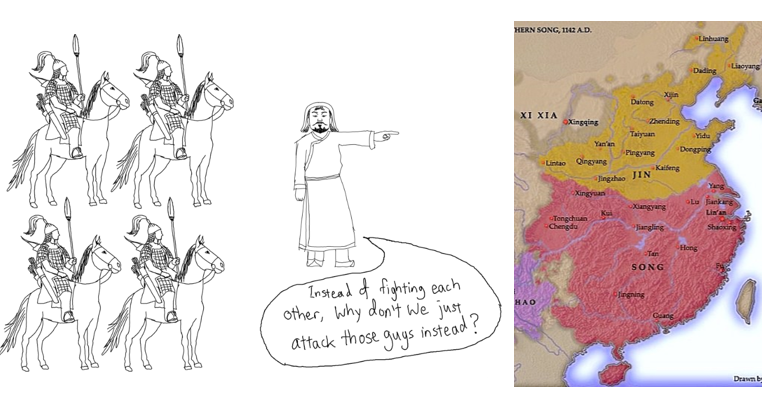
Additionally, animal husbandry created nomadic pastoralists like the Mongols, Bedouins, Cumans, etc. and yielded meaningful growth surplus, theoretically far more than the farmer. Only the size and defensibility of one’s herd mattered. One herder working full-time could produce enough food for an entire family assuming the herd and grazing pasture are sufficiently large, resulting in a growth surplus of several hundred percent, significantly higher than early agriculture. This was the reason why nomadic pastoralist societies could mobilize massive armies relative to their total population, whereas sedentary societies could not. In fact, the herder is merely extracting the growth surplus of his herd! He just has to find good pastures for his herd and protect them from predators. The “capital” for nomadic herders is their herds, which are mobile, self-producing, and self-replicating, though extremely vulnerable to severe weather events that can kill entire herds. Such conditions incentivized these societies to institutionalize warfare, as raiding became a regular part of life, capturing herds, horses, and wives/slaves. Note that nomadic pastoralists spent their surplus on war rather than on building big monuments and palaces like the sedentary civilizations did. Unlike land, which one have to attack and then defend later (and worked on via innumerable laborers), herds can easily be stolen – the raiders can be many miles away before the original owners can regroup and seek them out. Consequently, the vast majority of the male populations of nomadic societies have training and experience in battle and can readily mobilize for war. Nomadic societies historically expended a tremendous amount of people and resources in endless inter-tribal conflicts and family feuds. Neighboring sedentary civilizations quaked in fear when the tribes occasionally unite behind a charismatic leader in the pursuit of a common cause – consolidating the energy and resources they otherwise would have expended in infighting towards conquest.
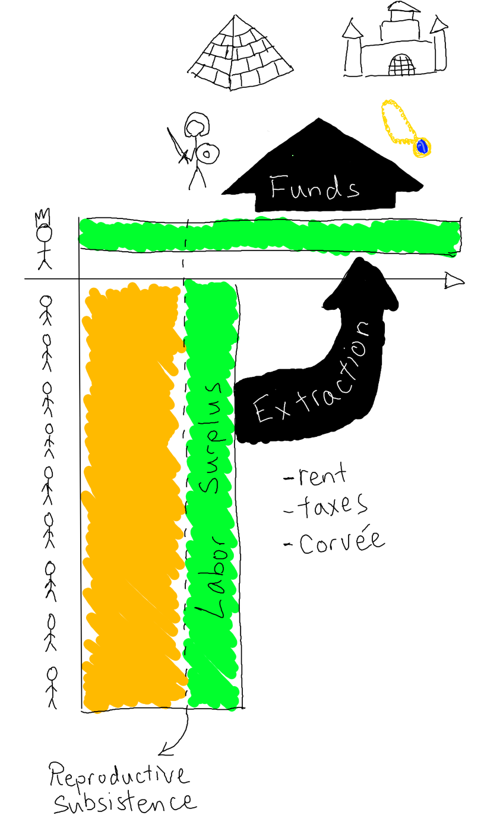
Agriculture and animal husbandry massively increased the theoretical maximum human population that a given area of land can support. Thomas Malthus theorized that humans would eventually reach the maximum supportable population of the earth. His argument would only be valid if resources not spent on survival were 100% allocated to reproduction, which is clearly not the case. Instead, Marx was correct in that growth surplus (he called it “labor surplus”) was instead extracted by a class of ruling elites, who spend it on: 1) luxurious frivolities (often in the form of art, religious idols, monuments, tombs, palaces, etc.), 2) wars to accumulate more resources, 3) various means to cement and strengthen their positions both relative to other elites and relative to the masses like hiring/training soldiers, building castles, etc. Extracted surplus doesn’t have to be in the form of crops or currency – it could be time and labor. For example, farmers would be allowed to farm enough to generate sufficient food for reproductive subsistence, then their remaining time is extracted via corvée, i.e. conscripted labor (sometimes for war) rather than taxes. Of course, it’s not always for vanity projects like the Pyramids, as sometimes, the corvée was for the construction of infrastructure (e.g. irrigation or dams).
Moreover, we find that the conditions inhibiting polygyny vanished. The presence of growth surplus at the societal level enables the perpetuation of meaningful inequalities, whereby a ruling elite extracts all societal growth surplus, reducing the vast majority of the population to reproductive subsistence (at times even below that threshold). Thus, the ruling elites were able to afford multiple wives and concubines – both in acquisition (e.g. paying a bride price to compensate the bride’s family for the loss of her labor) and in supporting the numerous women and children. It is, then, no surprise that after the advent of agriculture, only a minority of men have reproduced, whereas most women did (~80%). This wasn’t the case prior to the neolithic age. The explanation was a combination of wars that killed many men and resource/wife hoarding by patrilineal elites.
Legitimacy – justification for inequality
The in-depth discussion of the ways in which the elites first emerged in Neolithic societies deserves its own book. However, below is a high-level overview.

There were different ways that the ruling elites justified their power and thus the massive inequalities in those societies: force, legal structures, and religion/propaganda (though with many practical administrative benefits like providing granaries as insurance for famines, coordinates infrastructure building, lending, and other financial and economic benefits). In fact, writing was invented by the early temples as a way of accounting for the vast sums of resources they collected from the farmers. Over time, secular political powers (e.g. kings) competed with and sometimes controlled the temples to derive their political legitimacy and consolidate resources. Legal structures include ownership of critical resources and capital – in neolithic societies, the elites owned the land and most of the herds. The use of force necessitated a professional standing army, which came later; force was used if legal structures were challenged by revolt. That said, even when force was a major component of elite entrenchment, it always existed in conjunction with other sources of legitimacy.

Ultimately, elite entrenchment came out of high relative bargaining power (to be discussed in later articles).
In ancient Assyria, the extraction became more onerous over time, as the masses were pushed further into poverty. The state transition from a kingdom of Middle Assyria into an aggressively expansionist imperial Neo-Assyria coincided with new taxes on the Assyrian people, including those on grains, straw, domestic animals, and transportation. While it is difficult to prove definitively, I strongly suspect that society could not generate sufficient growth surplus to support the new level of extraction by the Assyrian elites, which drove the state towards wars of conquest during the Neo-Assyrian era to backfill resources and labor extracted from the people. Who benefits the most from these wars? The elites – they took the lion’s share of the spoils and used it to build monuments and enrich themselves. Of course, any tribute sent from subjugated states would naturally flow to the king. Thus, the elites have institutionalized war to satisfy their endless greed, very likely driven also by their otherwise unsustainable levels of extraction from their own people. For commoners, the decision is straightforward – either he die penniless and wifeless or gamble his life in war to possibly get land and a wife if a campaign were successful and he demonstrated great skill in combat.
Nomad warfare
Most nomadic pastoral peoples followed this model of institutionalized warfare. In fact, nomadic pastoralists also captured wives as part of their plunder, since the chiefs had already monopolized the women in their own tribes to such an extent that meaningful portions of young men had no prospect for wives (reflected in the fact that bride prices were so exorbitantly high, given the supply/demand imbalance and economic inequality). The chieftains controlled the large herds and could easily afford to pay bride prices (recall that larger herds could multiply quickly, while small herds grew slowly). War became the outlet for these “excess” young men, but also primarily benefited the chieftains, who still got the lion’s share of the spoils. Stealing or capturing in war women and livestock were the principal means by which non-elites could attain wealth and reproduce. In fact, Genghis Khan’s own father stole his mother from a rival tribe, who would later seek revenge by stealing Genghis’s first wife.
The Assyrians were one of the first civilizations to develop the professional soldier class, as it outcompeted, for many reasons, the seasonal farmer-soldier, which was the primary source of manpower for militaries up to that point. In the mid-8th century BC, the Neo-Assyrian empire completed the conversion of their military from an army of seasonally conscripted farmers (typically summer wars that couldn’t last too far into the autumn harvest season) to full-time professional soldiers. Naturally, full-time professional soldiers were far more expensive and thus required even more onerous taxation. They also gave rise to civilizations built on top of forceful oppression – the Spartans were the perfect example, where 70-90% of their population was helot slaves, while the remaining were free citizens that constantly prepared for war (though really to protect themselves against a helot revolt, since the Spartans couldn’t deploy too far away from home anyways, fearful of that potential uprising at home).
Humanity hardly ever needs war were it not for the rapacious extractive elites. For the masses of people who fill the armies, going to war rarely ever pays off, as they gamble their lives on behalf of their overlords. While there have been many documented instances of more egalitarian and peaceful ancient civilizations, none exist today. Unfortunately, societies that practice institutional warfare would conquer them – it should come as no surprise that warmongering civilizations tend to be quite good at war. It should be obvious to anyone with half a brain that any political ideology that advocates for a weak state would just end up conquered and enslaved.
Past subsistence, people mainly care about relative prosperity
The introduction of agriculture and animal husbandry has allowed the average person the potential to achieve growth surplus while also undermining the importance of cooperative gaming. Close non-family cooperation mattered less for survival, so zero-sum reproduction instead took priority. We can thus see the incentives thereof manifest in human emotions and moods – the feelings of envy and jealousy derive directly from this zero-sum game. As a result, insofar as a reproductive subsistence level of resources is assured, humans primarily care about relative prosperity, NOT absolute prosperity. For example, if you tell a poor person living in the West that their lives are much more comfortable than the typical lord in the medieval era, they wouldn’t feel any better about their lot in life. That’s because only relative prosperity matters – a person competes in a reproductive zero-sum game within their society, not the society of some bygone, less developed era.
I recall reading about an anecdote years ago. To contextualize it, the story took place in southern Italy, where earthquakes regularly struck. It was the great equalizer – the poor, the rich, the smart, the dumb, the pious, the blasphemous – all were hurt. People took it in stride; it was a fact of life – you rebuild and then move on. However, there was one incident when a woman’s house collapsed, and she was trapped in the debris. When rescuers tried to pull her out, she had already lost her will to live and tried to refuse help – she had assumed her house collapsed due to faulty construction. However, when they told her that an earthquake had hit the town and lots of people’s houses collapsed, her mood brightened, and she regained her will to live. Nobody likes to be alone in misfortune, because that would imply their social standing and thus reproductive chances took a hit. Beyond subsistence, only relative prosperity matters.
People seem to love zombie movies, where the main characters are thoroughly prepared to survive against endless hordes of undead. People tend to fantasize about prepping for the apocalypse – taking a certain degree of joy in it. When the end times come, I suspect they will be almost gleeful at the opportunity. Why? Because they will presumably have secured a bare minimum of survival and face significantly less competition for mates. Beyond subsistence, only relative prosperity matters. Which is preferable: living as a middle-class person in a lower-class neighborhood or living as a middle-class person in an upper-class neighborhood, all else equal? Some may choose the latter due to considerations for property value appreciation, crime, public infrastructure, networking opportunities, etc., but there’s no denying that the former option is highly attractive, especially for young, unmarried men. In fact, many doctors choose to live in rural areas, because their relatively high incomes and status would instantly render them respected elites within those communities. Those doctors wouldn’t command the same level of respect living in communities with large numbers of well-paid lawyers or tech employees. Beyond subsistence, only relative prosperity matters.
The cooperative spirit is embedded deep into the human psyche, esp in collectivist cultures
Despite the surplus provided by agriculture and animal husbandry and despite the zero-sum gaming of reproduction, the common man is incredibly cooperative and pro-social. It is only in today’s hypercompetitive, ultra-materialistic, and ultra-individualistic cultures (especially from north and northwestern European cultures like Nordics, Germanics, and Britons), where we see a real apathy for the suffering of others. Many cultures hold a deep cultural and often spiritual significance towards hospitality and treatment of strangers, especially those that developed in rugged environments. Arabs, for instance, are famous for their hospitality, as denying it to a stranger could mean their demise in the harsh Arabian desert. In fact, to the best of my knowledge, almost all non-European-or-European-descendent cultures place great value on hospitality for strangers. Even the Greeks do.

In fact, Asian cultures tend to be highly collective, whereas European cultures tend to be individualistic. Scholars have hypothesized (The Rice Theory of Culture) that this was due to farming and survival needs. In East and Southeast Asia, rice farming was the primary source of food, which necessitated collectivist cultures, since the paddy rice was very difficult to grow and relied on complex irrigation managed by an entire village. A single family couldn’t handle the labor alone. People simply must get along to farm rice (though the elites certainly didn’t have to get along with the peasants). For nomads in Central and West Asia, cooperation was still critical for survival when traveling alone, where hospitality was an insurance policy in the untamed steppe, desert, or mountains. If nobody followed hospitality etiquette, everybody loses.

In contrast, Europeans farmed wheat, which relied on rainfall rather than extensive irrigation. It also required far less labor than rice. Given sufficient land, a single family can farm a plot of wheat independently (which is why homesteads were possible on the American frontier). The wheat farmer simply didn’t need the village to survive. Recall the homesteader on the American frontier was hailed as the exemplar of rugged individualism, and it was all thanks to wheat farming. Unfortunately for these homesteaders, humans are deeply social animals, and prairie madness was a real problem for these isolated families.
What motivated the members of a hunter-gatherer tribe to work hard? The survival of their tribe and, consequently, their own survival – to achieve and maintain reproductive subsistence. What motivates the members of modern society to work hard? Reproductive subsistence is relatively easily achieved, especially since monogamy is legally enforced; why, then, do people push past that point? One reason is to provide a strong enough foundation to ensure their kids get the best shot at climbing the social ladder – it’s better to have 2 kids who are college educated than 6 that flunk out of high school. Beyond that, the urge to accumulate remains, even if the goal it was intended to incentivize became irrelevant. Humans are smart enough to hijack their own biological reward systems for personal pleasure and self-satisfaction. Addiction to the accumulation of power and wealth is no different than the addiction to carnal pleasures.
Key takeaways
The main point I want the reader to take away is that evolutionary game theory created human behavioral patterns. Broadly, humans have the capacity for great pro-social virtue, courtesy of our cooperative hunter-gatherer past, and the capacity for incredibly anti-social vices, courtesy of our innate drive to maximize reproductive opportunities. We can thus understand why elites have insatiable appetites for resources and power – they are a product of evolutionary game theory. It’s silly to ask, “why are the rich still so greedy despite having more than enough than they could possibly ever need for their families,” because that’s not the right framework to understand the behavior. It was never about providing for one’s family. Of course, that’s not to excuse all the heinous crimes elites over all of human history have committed to consolidate their power, but understanding elite behavior goes a long way towards foiling their plans, since their interests are diametrically opposed to those of the masses.
I felt it necessary to trace the origins of the behavior patterns of the elites, and to that end, this article serves as the prelude to my next series of articles, which will lay out what I call Incumbency Theory. I believe it is the best framework to understand power structures and dynamics within human societies. Karl Marx was correct in his use of historical materialism (an idea asserting that economic incentives and interests, as well as the distribution of resources and powers among different groups of people are the central driving forces in human history) to interpret historical societal changes and conflicts. Nobody is as proficient as the elites, by definition wealthy and powerful, in manifesting their economic and political interests into realities. Across history and geography, elites have an insatiable appetite for accumulation of wealth and power, and that rapaciousness has caused no end of troubles for their people and many others. As I will demonstrate in my future articles, elite behavior is thoroughly predictable – we can easily find patterns across history and in today’s societies. Let’s dispense with false pretenses and narratives and examine how elite machinations really work to undermine the interests of all peoples, countrymen and foreigners.
With all that said, I do NOT want the reader to walk away thinking that this is just some commie scum (I’m no Marxist) railing against the existence of inequality. I do not, by any means, want to deprive highly capable people the opportunity and incentive to create value for society and enjoy the fruits of their labor. Instead, my ultimate goal is to identify the greatest threat to human prosperity historically and how it works, then provide a solution to break the cycle of feudalism. Inequality in of itself isn’t necessarily the problem, but rather the mechanisms by which inequality deserve a lot of attention, as they portend just what kind of incentives pervade that society and what kind of future they portend. To me, someone getting rich off of creating new technologies that make everybody’s lives better should be celebrated; conversely, someone getting rich by accumulating leverage over society for the purposes of surplus extraction should be shunned. Unfortunately, the former almost always becomes the latter over time.
My next article will discuss relative bargaining power, the only factor that matters when it comes to the distribution of resources and privileges. Both capitalist economic and Marxist labor theories fail to properly account for this dynamic, which is the linchpin to understand how structural inequalities persist and worsen over time.
Please note that I have started posting on Substack for better reach. I will use this blog as a backup for my Substack.