In my first two articles on relative bargaining power (RBP), I defined the concept on a theoretical basis, then gave numerous real-world examples. In this article, I will reconcile RBP with existing economic theories, specifically with Marxist economic theory and neoclassical economic orthodoxy.
This article will be organized as follows:
- Normative economics is foolish
- Refuting normative Marxist theory
- Refuting normative liberal theory
- Folly of liberal economic policy
- Demand-side (progressive/Keynesian) folly
- Supply-side (Chicago school neoliberalism) folly
- Applied theory: value chains – how RBP extends influence to indirect counterparties
- Example: pharma value chain
- Example: tariffs and who really pays them
- Test your knowledge – why aren’t smart people rich?
Folly of normative economics
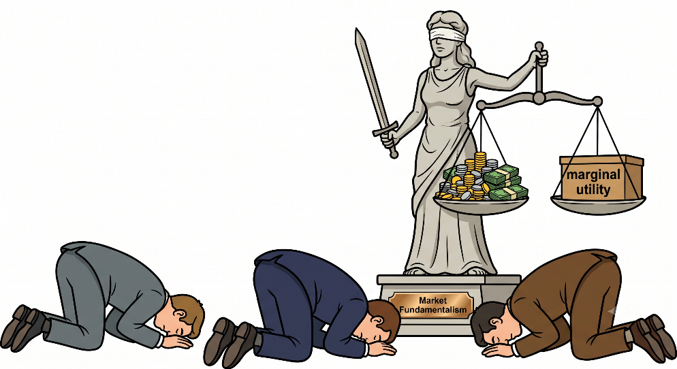
Both neoclassical economics (the prevailing normative economic theory underpinning modern capitalism, which is based on the political ideology liberalism) and Marxist labor theory of value (normative economic theory underpinning communism) pass moral judgment on how society and the economy should be arranged. Whereas the Marxist theory worships labor, neoclassical economics worships the market, property rights, and the sanctity of contracts.
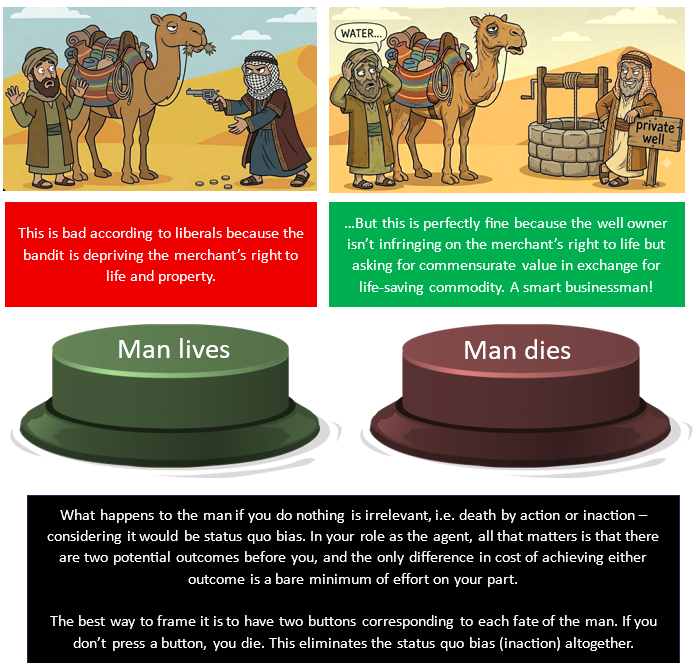
The fundamental flaw of normative economics is that it arbitrarily draws lines in the sand and passes moral judgment – for example, liberals draw the line at the use of force, yet there is no practical difference between extorting someone with the threat of force and extorting someone starving despite having plenty of food. It’s simply status quo bias – it feels ickier to cause someone to die from action rather than inaction. In contrast, RBP is purely a descriptive theory; it provides the analytical tools with which decision-makers can understand how to effect change.
Refuting normative Marxist theory
The labor theory of value (which Adam Smith also believed) is at the foundation of Marxist economic theory and presupposes that the value or price of a good or service is determined by the labor required to create it, thereby framing all profits as capitalist appropriation of workers’ surplus value of labor, i.e. price of the good or service minus subsistence wages. By extension, the theory holds that all private ownership of capital (means of production) is derived from exploitation of labor, i.e. depriving labor its due surplus. Thus the only way to break the exploitation is for the state (socialism) or the people (communism) to own the means of production.1
In pursuit of this ideal, Soviet state owned the heavy factories managed by designated directors. Instead of ownership, the Soviet elites merely controlled the means of production (e.g. directors of factories and the Nomenklatura in the USSR), which granted them substantial bargaining power over the people; that leverage translated into privileges and luxuries for the elites and their families.2 Factory managers also frequently hoarded inputs, capacity, labor, and inventories to preserve their own positions, which resulted in massive inefficiencies and shortages in the economy. The exact same problems arose in Mao’s China, after they adopted many aspects of the Soviet systems. Ownership matters insofar as it grants the right to profit and control, but if bureaucratic positions granted the same rights, RBP persists without legal ownership (though in the case of socialist countries, absolute accumulation was constrained by state authority, i.e. if you hoarded too conspicuously, you would be purged). Case in point – as of recent years, approximately 60% of the contemporary elites in Putin’s Russia can trace their family’s membership in the Nomenklatura, ~35 years after the fall of the USSR. Many of them quickly became billionaire oligarchs in the shock therapy years after the USSR collapsed, primarily through purchasing state assets at fire sale prices. We can conclude that while ownership of the means of production is one way of achieving high bargaining power, it isn’t the only way.
Marx intuitively understood the dangers of capitalists who can consolidate substantial RBP, via property ownership, over both the people and the state, extracting from all. But he failed to foresee that administrative control over those same means of production results in the same power and thus accumulation of privileges and resources (albeit to a lesser extent with the iron hand of the state).3 This disconnect is due to his moralization of private ownership of the means of production as the unique source of oppression, which blinded him to the bigger picture. Owning the means of production is merely one of many ways of accumulating high bargaining power vs counterparties. A communist intellectual Milovan Dilas, disillusioned by the USSR, wrote in his book The New Class: An Analysis of the Communist System, that “ownership is nothing other than the right of profit and control. If one defines class benefits by this right, the Communist states have seen, in the final analysis, the origin of a new form of ownership or of a new ruling and exploiting class.” Simone Weil, a French philosopher and left-wing libertarian, contended that the Soviets subjected the people to the same the capitalist forms of power and oppression but merely held by the state. Dictatorship of the bourgeoisie has transformed into dictatorship of the proletariat Party. Additionally, while Marx accurately intuited that capital typically has higher relative bargaining power over labor, it isn’t always true. Marx had failed to grasp the nuance from RBP and defines the private ownership of capital as inherently exploitative and oppressive. In fact, organized labor sometimes has so much bargaining power they become almost like Rockefeller, extracting rent from the public – this is precisely why Franklin D Roosevelt famously held strong sympathies for private sector labor unions but opposed public sector unions.4
The ILA and ILWU
The International Longshoremen’s Association (ILA) is a union for port workers across the East Coast of NA, the Great Lakes, the Gulf Coast, and Puerto Rico. Their analog on the West Coast is the International Longshore and Warehouse Union (ILWU), and combined, they control the labor forces of almost all the ports (critical infrastructure) in the US. Considering that Americans’ standard of living rests on top of imported goods, maritime imports are a key chokepoint of the US economy. They are probably two of the most egregious unions in existence, frequently holding the American economy hostage to extract concessions.

The ILA (handles ~60% of US import/export container volumes) and ILWU (handles the remaining ~40%) are unions representing ~110K longshoremen across North America. While they do not strike together (legally and contractually forbidden, otherwise that would be overwhelming bargaining power), they try to take solidarity with the other when one strikes by slowing down the processing of containers diverted to their port. They also typically use each other as a basis for negotiation, citing the other union’s raise to justify demanding their own raise to meet or beat it (referencing each other’s contracts as floors for their own negotiations). A strike by the ILA could cost the US economy $3.8B to $4.5B per day, an immense amount of bargaining power for a small group of people.

Through this imbalanced bargaining power, the unions extract concessions like:

High pay: base of $42-81K (with $29K per year in health, welfare, and pension contributions per worker), with some making >$200K annually, among the highest earning blue collar workers in the US

Container royalties, which pay workers based on volume of containers processed, resulting in an extra $15-20K per year (this was originally a concession to the union for ALLOWING ports to shift to containers, a technology that reduced the number of workers!) Typically, only the most privileged employees like executives can negotiate for a share of company revenue like this.

Guaranteed annual income (GAI) is particularly egregious, as it is guaranteed pay for eligible longshoremen of a full year’s salary (based on a standard number of hours), even if there were no work for them to do (upwards of $400K in 2010). The system was very easily exploited by highly paid people who rarely, if ever, worked. Note that ILWU has the Pay Guarantee Plan (PGP), which pays registered longshoremen who make themselves available for work even if they aren’t hired (due to not enough work available).

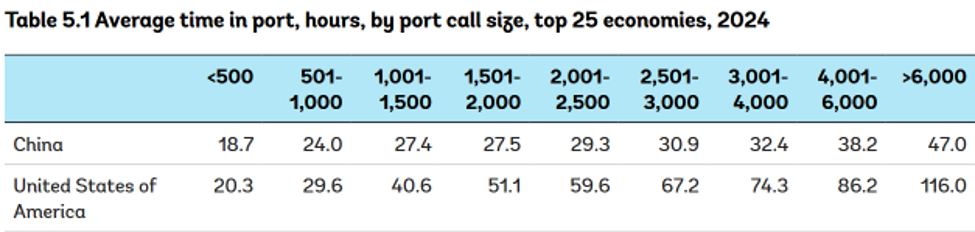
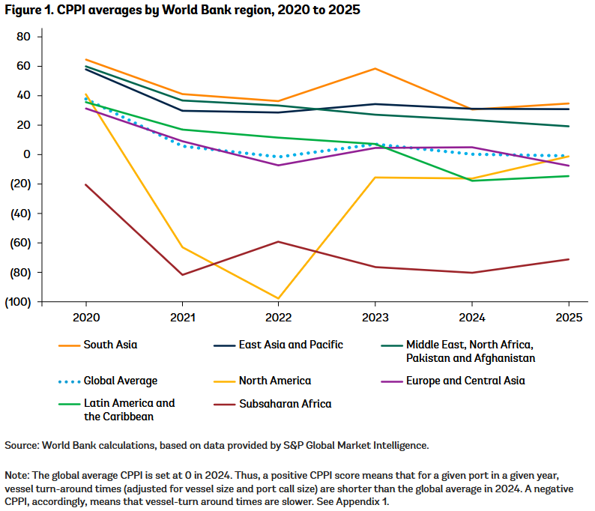
Near total opposition to automation – the worst is probably the lost efficiencies, as the unions refuse to let any automation into American ports for fear of losing their jobs and container royalties. As a result, American ports rank poorly in the world for efficiency. The average Chinese port is more than twice as efficient as the average American port for almost all port call sizes. China also has ghost ports, where fully automated vehicles and cranes move and stack containers with no human drivers. Most major non-US ports operate 24/7, with hot seat shifts. US ports often significantly slow down on nights and weekends due to strict union-negotiated overtime rules. The top 5 American ports by cargo volume rank 88 (LA), 305 (Long Beach), 117 (NY/NJ), 377 (Savanah), and 334 (Houston) out of 400.

All of this is paid for in lost surplus primarily by American consumers, who have the least bargaining power. While ILA’s and ILWU’s privileges may seem extreme, in theory, they would have even more bargaining power if it weren’t checked at the extreme end by the power of the state. If ILA or ILWU maximally flexed their leverage, the federal government would crack down, possibly dissolving the union.

Recall that in October 2024, just before a contentious Presidential election, the ILA maximized their leverage by going on a huge strike, which would have caused inflation to spike if prolonged. Recall that inflation was still a major problem for the incumbent president, front and center in the minds of the voters. As a result, the Biden administration had to quickly resolve the issue, lest it damage Kamala Harris’s reelection chances. Thus, the ILA ended the strike in just 3 days, securing a fat 62% raise over 6 years and protections against automation. Note that this is significantly faster than inflation, while average wages lagged inflation.
Bargaining power of labor
Sufficiently skilled workers can wield high bargaining power relative to employers. Because there are typically high barriers to entry for these jobs, workers can command greater share of their surplus value of labor, manifesting in higher pay and better benefits. Examples include lawyers, doctors, consultants, engineers, and financial analysts. Additionally, many of these workers can simply start their own companies – their professions are service-oriented and thus don’t typically require substantial company capital to provide value for customers (unlike unskilled factory workers, who would need heavy industrial machinery to provide value). If big consultancies stopped paying high salaries to their staff, many could just leave and set up their own shops, poaching teams from their old employer. One recent example was the high-profile departure of Jonathan Orszag from FTI Consulting to set up his own shop, taking a number of colleagues with him; this resulted in a loss of $35M in operating profits for FTI.

In a generic company, the vast majority of workers have little to no profit-sharing. In contrast, many professional services businesses like law, consultancy, and independent medical firms provide profit sharing and often offer partnership equity in the firm. In that sense, these companies more closely resemble the workers’ cooperatives envisioned by Marx than most others – they can demand such arrangements because they have bargaining power.
Refuting normative liberal theory
At its core, liberalism asserts that consent5 is the ultimate good and that force is the ultimate evil. In reality, the threat of force is just one of many sources of RBP. This normative framing has been adapted into an economic framework via neoclassical economics (the purest adherents thereto are known as “neoliberal”), which is the prevailing economic orthodoxy in the Western world today. The purest ideological manifestation of liberalism is libertarianism, which maximizes the glorification of voluntarism and the condemnation of the threat of force. In other words, liberalism draws a clean line in the sand between the threat of force versus all other sources of RBP, when in reality, force is just one of many.
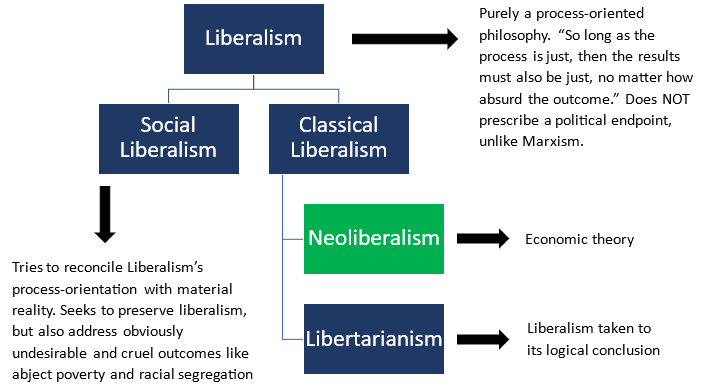
Simply put, liberalism (and by extension neoclassical economics) asserts that a society is just if and only if all transactions are voluntary and devoid of the threat/use of force. Voluntarism = freedom, and maximizing voluntary transactions = maximizing freedom = everybody is better off over time. This is the bedrock axiom of liberal ideology, upon which all of its corollaries are built. Social liberalism (often known as “progressivism”) adds pragmatism to liberalism and thus seeks to correct the obvious injustices created by following this rule to the letter. However, progressivism is still liberal at heart, so it generally refuses to infringe on property or contract rights, thereby ignoring structural RBP imbalances.
Recall from Economics 101 class the idea of Pareto Efficiency, wherein a change is a Pareto Improvement if at least one person is made better off and nobody is made worse off. This provides the mathematical framing of a voluntary transaction, because nobody would voluntarily make themselves worse off unless they’re extorted by force (the ultimate evil). A Pareto Improvement = a voluntary transaction.
Therefore, if we synthesize liberal ideology that voluntarism = just, then a society that only allows for Pareto Improvement changes (voluntary transactions) must necessarily be a just society where people are better off over time. If we can disprove this claim, then we will have disproved the liberal normative axiom that a society based on the freedom to make voluntary transactions (assuming no negative externalities) must necessarily be just and nobody would never be made worse off over time. Expressed in mathematical terms, if Tx are Pareto Improvement transactions, then the aggregate of Tx must be a Pareto Improvement as well.
Liberalism assumes that:

Exemplified by the quote:
“Whatever arises from a just situation by just steps is itself just.” – Robert Nozick
Suppose I buy a product from a vendor every year for $100, and the maximum price I would pay is $150. Therefore, my consumer surplus is $150 – $100 = $50. The vendor’s marginal cost is $70, so the seller surplus is $100 – $70 = $30. The total surplus created by the transaction is $50 + $30 = $80. This is a Pareto Improvement – we both consented to a mutually beneficial transaction.
Suppose this year, before I had an opportunity to buy the product, the vendor acquired several competitors such that their bargaining power relative to customers increased. The acquisitions must also necessarily be Pareto Improvements, because otherwise, the vendor wouldn’t convince the sellers to sell their companies. We’ll aggregate these transactions as A.
Due to reduced competition, the vendor can now charge $130 for the product. I still buy it this year, because I still value it at $150. My consumer surplus is now $150 – $130 = $20. In contrast, the vendor’s seller surplus is now $130 – $70 = $60. This is still a Pareto Improvement, because both the vendor and I gain surplus from the transaction and thus it is voluntary. We’ll call this transaction B.
Therefore, we have shown that both A and B are Pareto Improvements. In theory, A + B must also be a Pareto Improvement… but this isn’t true. Compared to last year:
- My consumer surplus declined from $50 to $20
- The vendor’s seller surplus increased from $30 to $60
- Total surplus is still $80, but the vendor gained $30 surplus at my expense, due to increased bargaining power from eliminating competitors
Ergo, I have demonstrated that a voluntary society can create an unjust society. Again, the problem with voluntarism is that it is structurally blind to sources of RBP that are non-force. It could not see that the vendor eliminating competition deprived customers of alternative options and is thus a zero-sum play where the vendor increased its own RBP at the expense of its counterparties, later manifesting in pricing power.
Pure technicality (for those interested)
In theory, if we take the strictest definition of Pareto Improvement, A would technically be disqualified, because reducing the customer’s alternatives could count as a negative externality (someone losing out from a transaction they’re not party to) the same way that a company polluting a river would. This is because if we defined “externality” that broadly, someone buying any scarce good would be a negative externality for all other buyers, since that person would be depriving a product from all potential buyers and possibly causing the price to increase a bit. A definition that broad would render the entire concept of Pareto Efficiency useless, so changes in bargaining power are excluded as a negative externality.
An honest liberal would have no quarrel with feudalism, because the serfs or indentured servants technically agreed to the conditions of their employment and the usurious debt mathematically designed to keep them trapped. Similarly, the liberal would oppose the liberation of serfs from debt peonage, arguing that the serfs would be violating their contract obligations to the lord.
Folly of liberal economic policy
Because liberalism suffers from power-blindness, so too does liberal economic policy; it has no concept of RBP. Consequently, liberals suffer from status quo bias – the assumption that the status quo is a neutral and fair starting point, basically a blank slate. Failure to alter RBP means failure to structurally shift surplus distribution. Modern liberal economic policy is split between two primary camps: demand-side (progressive/Keynesian) policies and supply-side (neoliberalism) policies. Whereas the former subsidizes demand with direct payouts to the people via welfare, housing subsidies, etc. or government spending to drive aggregate demand, the latter subsidizes supply via tax cuts to the capital class and deregulation of corporations.
Liberal ideology is their common heritage, with both accepting the market as sacrosanct, refusing to infringe on the sacred cows of property rights and contract rights. Instead, the way the two mechanisms differ is how they go about fine-tuning the markets. Let’s examine how these liberal economic doctrines ignore RBP and thus fail to achieve their intended objectives.
Demand-side interventions
Western policymakers frequently reached for cash redistribution because they have an aversion to impeding what they see as inalienable rights of property and “individual liberties.” Progressive liberalism loves to throw money at problems to fixed injustices created by the process-oriented system. As a result, the go-to mechanisms to address poverty never tackle the real sources of power for the elites, i.e. the sources of their substantial bargaining power. Instead, the debates endlessly revolve around subsidies and handouts, without understanding the bargaining power landscape of the system into which they’re paying.
For example, the US housing voucher system (called Section 8)6 is a federal program for assisting low-income families, the elderly, and the disabled in the private rental housing market. It is a rental subsidy for the poor. Landlords have to opt-in to the program and comply with various rules on maintenance and safety. The federal government would pay the landlord directly, with the program beneficiary paying the difference between the actual rent and the amount subsidized by the program. Typically, the participant pays maximum 30% of their adjusted gross income for rent and utilities, while the subsidy covers the balance. The supply of subsidies is very limited, and there are extremely long waitlists to participate.
The pitch for subsidies is straightforward – help low-income families afford better homes in the private markets rather than the dumpster fire of American public projects. However, given the tightness of the housing market in the US in the places where there are jobs, landlords wield substantial bargaining power relative to tenants (inelastic demand). A study published in 2002 found that voucher programs increase rents not just for subsidy recipients but for millions of low-income families that don’t benefit from the subsidy.
“In the 90 biggest metropolitan areas, vouchers have raised rents by 16 percent on average, a large effect consistent with low supply elasticity in the low-quality rental housing market. Considered as a transfer program, this result implies that vouchers have caused a $8.2 billion increase in the total rent paid by low-income non-recipients, while only providing a subsidy of $5.8 billion to recipients, resulting in a net loss of $2.4 billion to low-income households.”
Beyond housing, the US has pursued similar policies of subsidizing demand in supply-constrained markets like higher education, and healthcare. Unsurprisingly, despite all the subsidies, housing, higher education, and healthcare costs have increased at rates far faster than inflation. In contrast, subsidizing food through SNAP benefits results in increased supply without higher prices – it’s easy to bring new supply into the market to meet the increased demand.
Supply-side economics/Chicago School
Supply-side economics made famous by the University of Chicago is the archetypal neoliberal doctrine, whereby the government seeks to cut taxes for companies and high-earners rather than subsidizing demand. Although the proponents of supply-side economics never use the phrase “trickle down” economics, it is essentially the way they pitch it to the public – that tax cuts for the corporations would wound up benefiting the average person via new job creation and economic growth. I will save a lengthy discussion of Reagan/Thatcher for another time; let’s talk about Trump’s 2017 corporate tax cut. Trump had claimed that even wages would increase because of these corporate tax cuts, by $4,000 – $9,000 annually. Do companies really need to share the extra surplus with their employees?
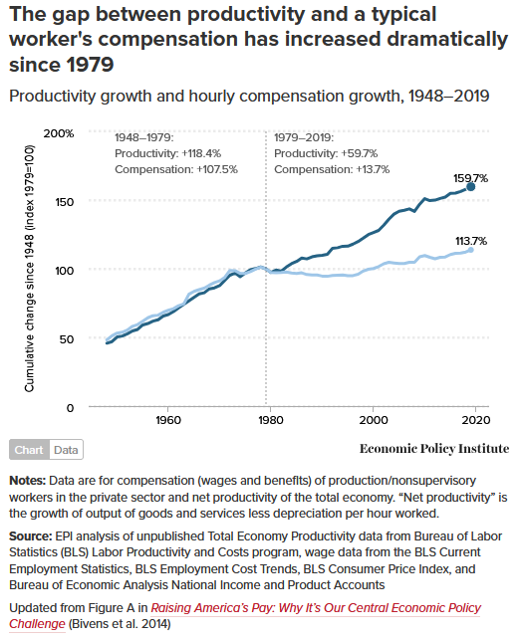
Well… who has higher RBP? A good proxy is to see the distribution of incremental system-wide gains, i.e. looking at who captured the biggest shares of surplus growth over time. Prior to 1980 (prior to Reagan), wage growth and productivity growth moved in lockstep – relative bargaining power was even between labor and capital. Productivity is basically the value of the output of capital and labor on a per capita basis, so if productivity growth equals median wage growth, then labor is capturing approximately the same proportion of surplus over time. However, median wage growth has consistently lagged productivity growth since 1980, implying labor’s bargaining power has been systematically eroded. What were some of the major causes?
- Reagan weakening unions
- Globalization – shifting manufacturing jobs overseas, opening new sources of supply for cheap labor
- Broad consolidation of industries, including by private equity, that has reduced the total number of employers, thus increasing industry concentration
- Since the beginning of the 21st century, HHI (metric of market concentration) has systematically increased in over 75% of US industries, with the average increase reaching 90%
- The evidence is abundantly clear that increasing corporate market share concentration results in reduced worker surplus capture, implying weaker labor bargaining power
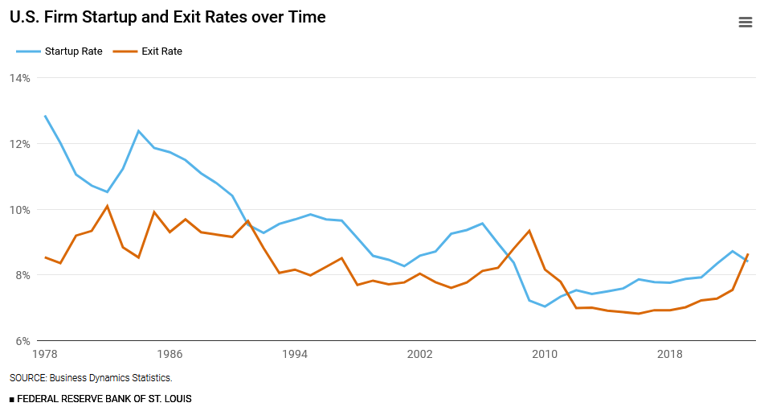
- Industry concentration also means declining competition and thus underinvestment (complacency).
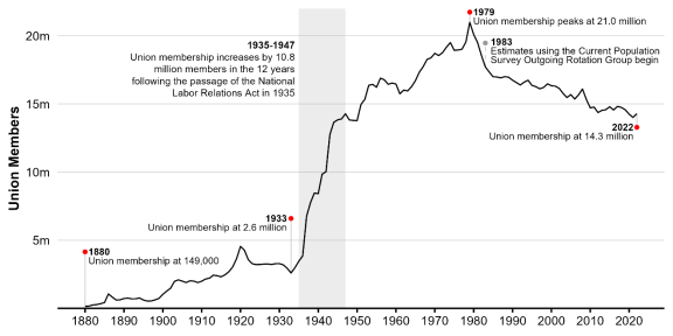
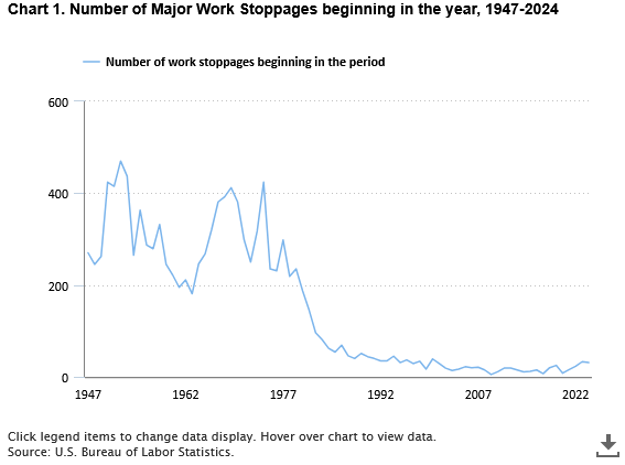
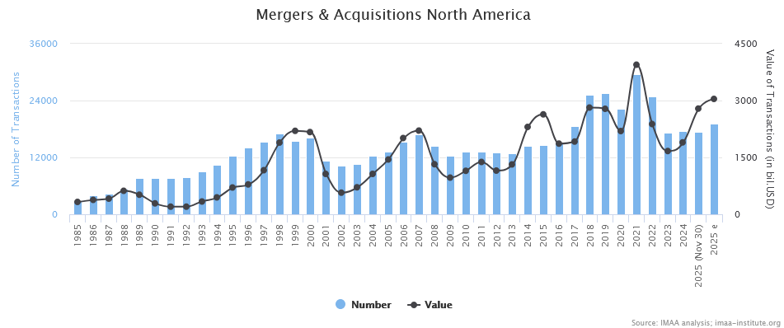
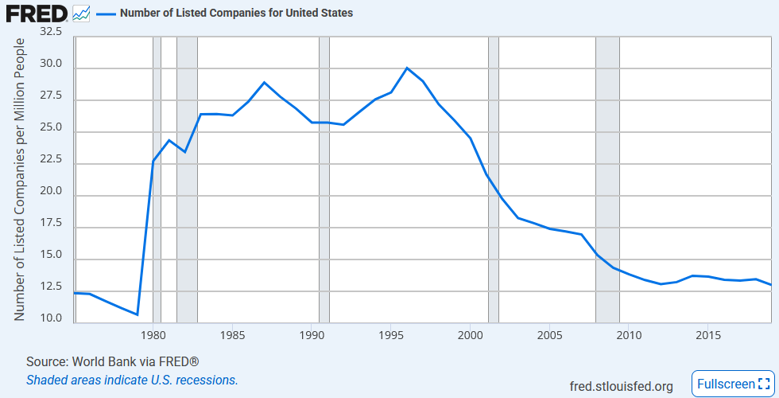
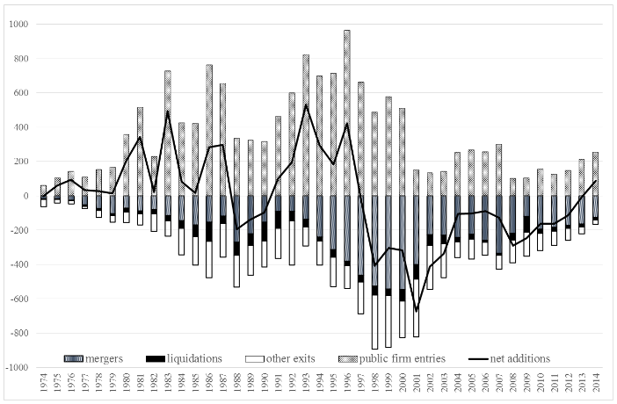
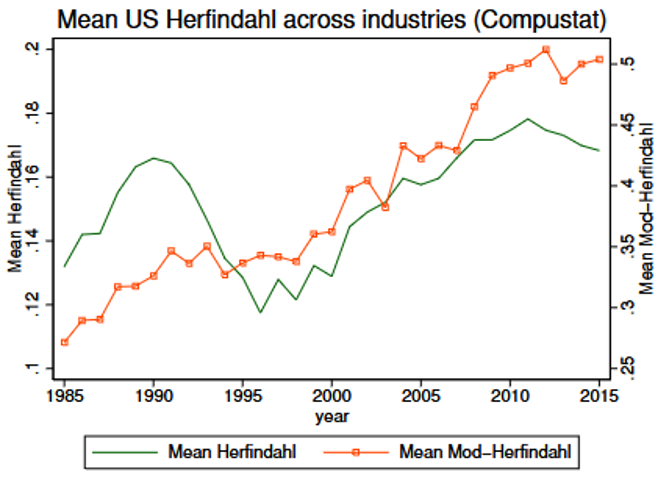
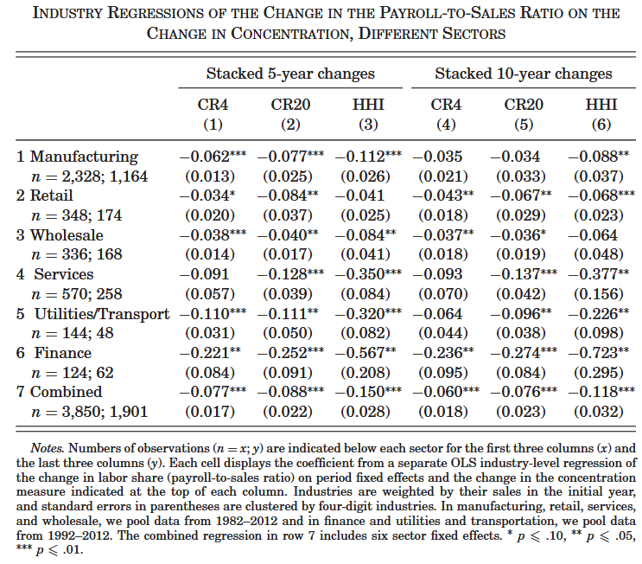
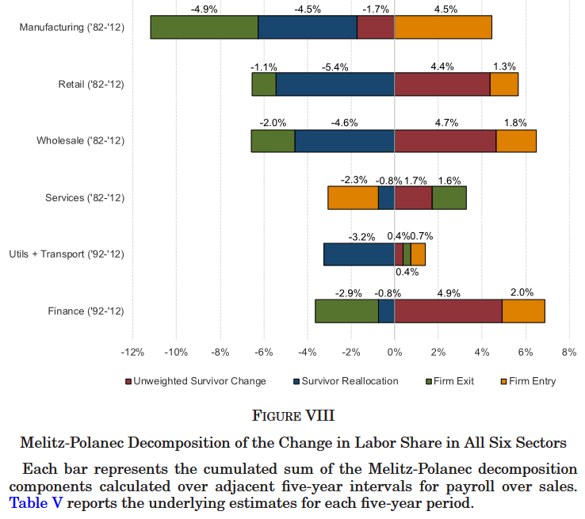
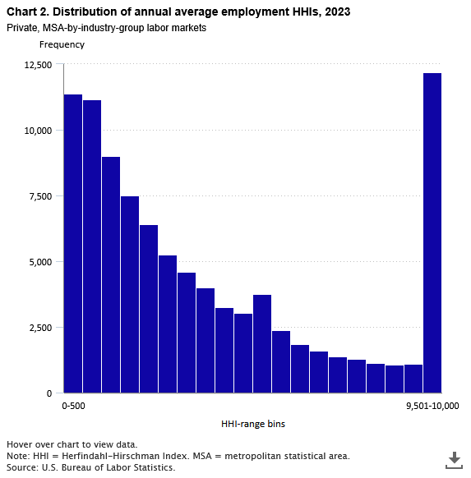
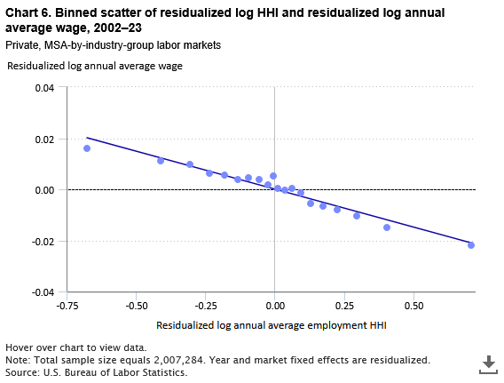
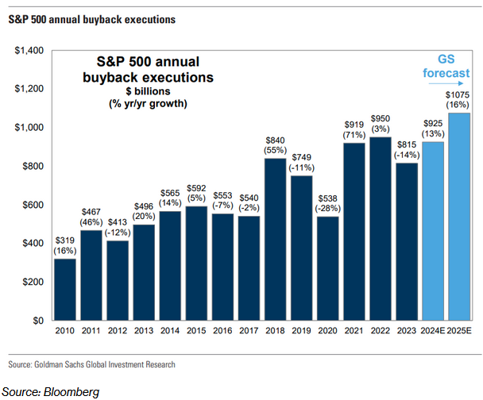
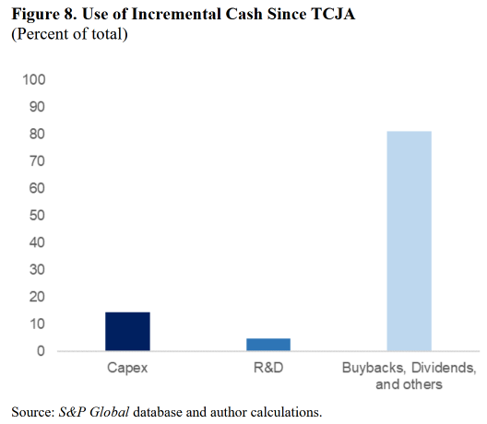
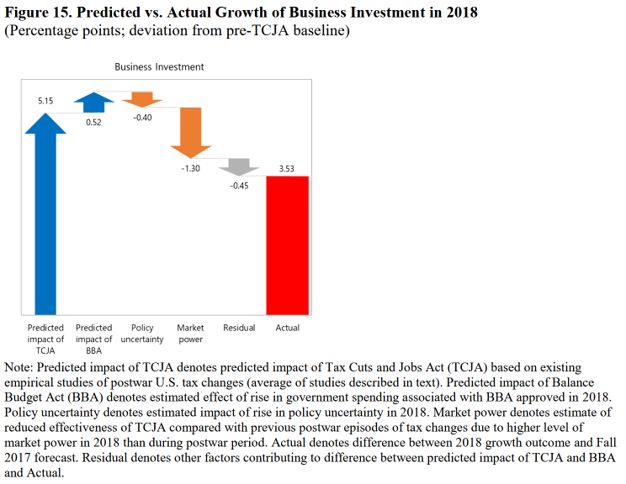
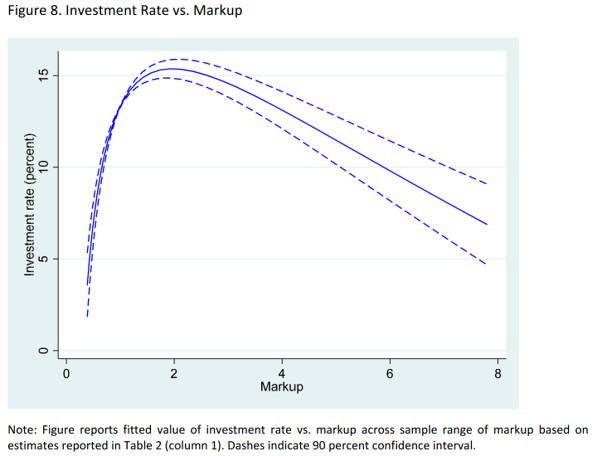
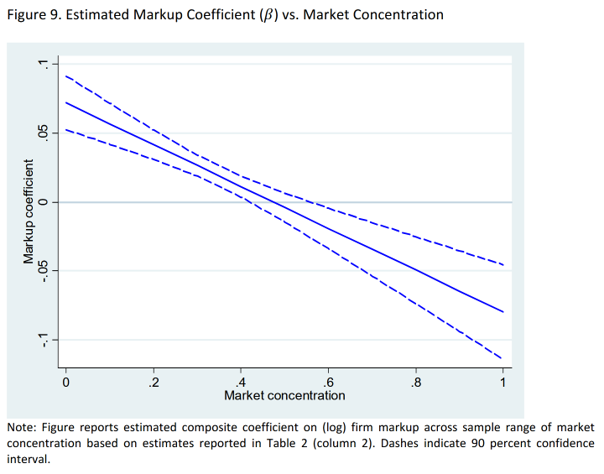
Given the demonstrable bargaining power advantage of the corporations, is it a surprise to know that Trump’s 2017 tax cuts (TCJA) have primarily flowed into the pockets of shareholders, via record stock buybacks while workers have gotten minimal increases in pay (~0.9% wage gain according to this study)? In fact, this IMF study directly attributes the primary reason of lack of flowthrough from the tax reduction to business investment is due to “market power,” which is a proxy for bargaining power, since studies approximate it with a metric very similar to gross margin (price divided by marginal cost). Another IMF study suggests that firms with sufficiently high market power are less likely to invest in capital expenditure, R&D, or higher wages for employees, especially in markets with little competition. This study argues that increased market share concentration explains a significant portion of low corporate investment. I would consider capital expenditure and R&D as contributors to customer surplus, whereas wages for employees are obviously employee surplus. The empirical evidence is decisive: high corporate RBP means greater concentration of surplus at the corporate level, at the expense of employees, customers, and other counterparties.
Myth of private market “efficiency”
Neoliberals extol the virtues of the private markets, especially efficiency. The typical refrain is, “private markets are more efficient and cost-conscious while state-run operations are bloated and inefficient.” While there is some truth to the claim, I argue that the bulk of the vaunted private market efficiencies come from squeezing counterparties (via RBP) rather than structural efficiencies (via capital formation).
First, let’s quickly review structural efficiency by capital formation. I have made a video about it here. Capital formation is when resources are expended to create capital stock to permanently increase labor productivity. In other words, capital formation enables the economy to create the same amount of output with less input. Capital formation is comprised of capital expenditures and R&D, which private enterprises hate spending money on unless they’re forced to by ample competition. If my organization invests in tools (capital formation) such that I need fewer raw material inputs than before, then my suppliers can reallocate resources elsewhere (perhaps to supply a new customer) to create abundance. This is the only way to create structural efficiency.
In contrast, private enterprises heavily rely on “relative” efficiency via squeezing counterparties. This is when a company would squeeze its suppliers and/or employees to extract price concessions, thereby increasing company margins. The company still needs the same amount of goods & services from their suppliers, but the suppliers simply get less money for the same output. The employees might be asked to do more for the same amount of pay. This is a zero-sum game – there is no abundance created, but simply surplus shifted from suppliers/employees to the company. For society at large, the same amount of material inputs (labor and resources) was used to create the same amount of outputs, but the profits (surplus) were redistributed within the system. The Chicago School morphed the entire ethos of antitrust enforcement by framing consolidation as “efficient,” thereby ignoring increased bargaining power from market share concentration. The Chicago School influenced the FTC and the courts to adopt a new standard of antitrust enforcement based on “consumer welfare” rather than market power.
In [the Chicago School’s] view mergers, particularly mergers that are not to monopoly, are usually efficiency increasing, and undertaken for that purpose. They argued that predatory pricing is an irrational business strategy because the predator loses money during the predation stage, and “if he tries to recoup it later by raising his price, new entrants will be attracted.” The logic is that firms face a reservation price on the bundle of tied goods, and have the option of raising the price of the tying product in order to obtain any available rents. Consequently, tying is not a profitable strategy unless it results in efficiencies. […] In sum, little to no antitrust enforcement was warranted. They maintained that big business seeks efficiencies, which benefit the economy as whole, and the previous antitrust policy had been harmful and unwarranted. In the crisis of the 1970s, the Courts would implement the minimalist Chicago School program.
Source

Unsurprisingly, the empirical evidence contradicts neoliberal dogma. This NBER working paper concludes that M&A does not create real efficiencies but rather shifts surplus away from counterparties (suppliers, employees, etc.).
Chaebols – neoliberal utopia
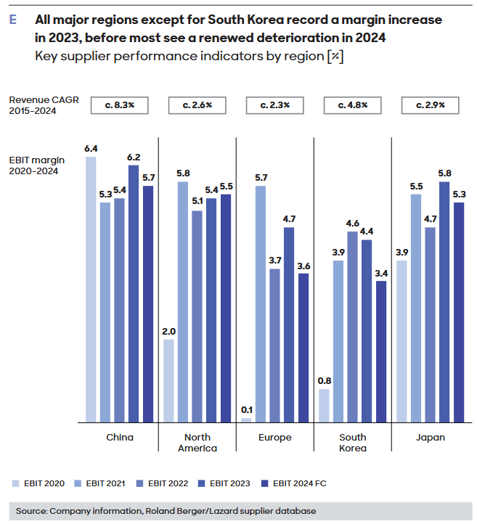
Perhaps one of the most egregious examples today are the South Korean chaebols like Samsung. The top 4 chaebols make up 40% of total GDP, while the top 30 make up 77%. Unsurprisingly, these behemoths happily flex their leverage over their suppliers to squeeze the profits out of them via monopsony power – this is why South Koreans fight for employment at the chaebols, as non-chaebol employers simply cannot pay an adequate salary or invest properly in R&D when their surplus is extracted by chaebols directly or indirectly. Because chaebols pay ~50% more than non-chaebol employers, they monopolize top talent.

For example, South Korean automakers rely on squeezing suppliers to maintain competitiveness. Consequently, South Korean automotive supplier margins are the lowest in the world (European margins are compressed by supply chain disruptions from the Russia-Ukraine War), more than halving from the 8.5% in 2010.
Let’s take a quick look at an example of private market “efficiencies” through scale. For context, the company in question, Allison Transmission, merged with one of Dana’s businesses earlier in the year, almost doubling total revenue. Unsurprisingly, there are cost synergies inherent in the merger – management estimates $120M annually. Where do these “efficiencies” come from? Mostly from flexing relative bargaining power.
- Greater purchasing power vs vendors
- Shifting production to lower-cost geographies, especially due to labor
- Employees doing more for the same pay (leveraging fixed corporate costs, e.g. HR now handling many more employees, accounting handling a bigger business)
Purchasing power is obvious, but shifting production lines outside of high-cost regions (North America) is also a major rationale for the acquisition. A large chunk of Allison’s labor force consists of high-wage union members based in Indianapolis, whereas the acquired business has significant operations outside the US, especially in India and Hungary. It’s not that Indian or Hungarian workers are more productive/efficient than American workers, but rather that they accept lower wages than American union workers. This provides the company with a powerful alternative to using expensive domestic labor, and as we know from Incumbency Theory 1.2, having alternatives is a source of RBP.
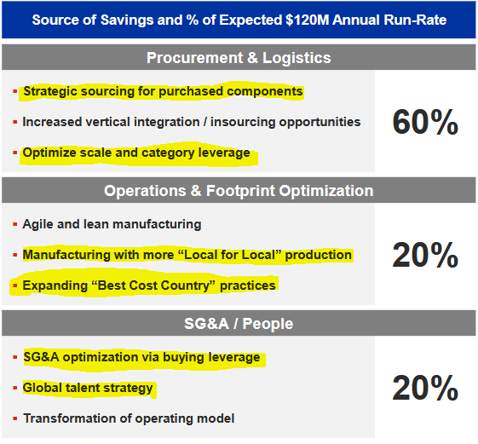
In sum, corporate consolidation increases RBP versus counterparties including employees, suppliers, and customers. The primary source of “efficiencies” come from flexing RBP on these counterparties to extract surplus rather than true structural efficiencies unleashed by capital formation. In fact, it is well-established that greater market share concentration, i.e. less competition, reduces capital formation. Some incumbent players would acquire new entrants to kill off and preempt future competition. Thus, despite neoliberal claims to the contrary, corporate consolidation and market share concentration not only result in few efficiencies but also undermine long-term societal prosperity.
Applied theory: value chains
Relative bargaining power ripples across chains of counterparties, such that the distribution of profits within a value chain reveals relative bargaining power of each node. Suppose node A has high bargaining power vs its counterparty node B, who has equal bargaining power vs its counterparty node C. When node A squeezes node B, the latter can ask node C to share some of the burden imposed by node A; thus, node A can extract surplus from node C by squeezing node B. In other words, RBP extends beyond two-party negotiation.
Conceptually, let’s look at a hypothetical value chain. Suppose a particular industry is worth $100, with the maximum price customers are willing to pay in aggregate being $150.
- Customer surplus = $150 – $100 = $50
- Retailer pockets $20 after paying $80 to the wholesaler
- Wholesaler pockets $10 after paying the manufacturer $70
- Manufacturer pockets $50 after paying the raw materials supplier $20
- Raw materials supplier receives $20 in revenue
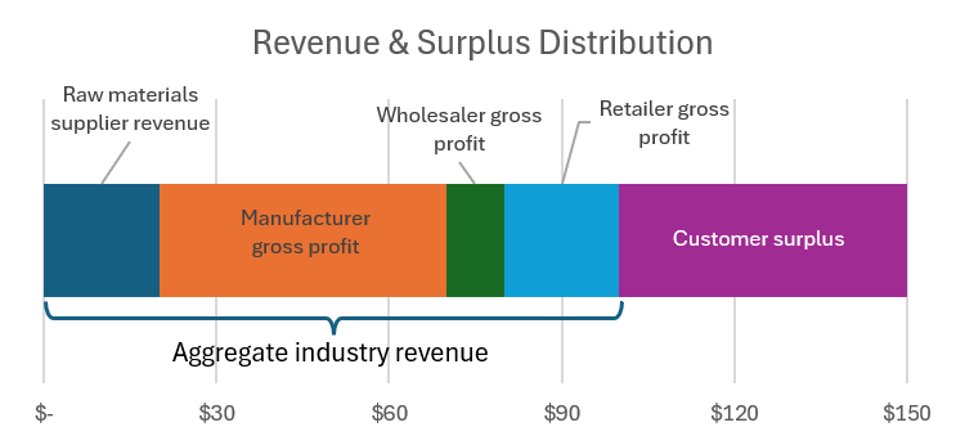
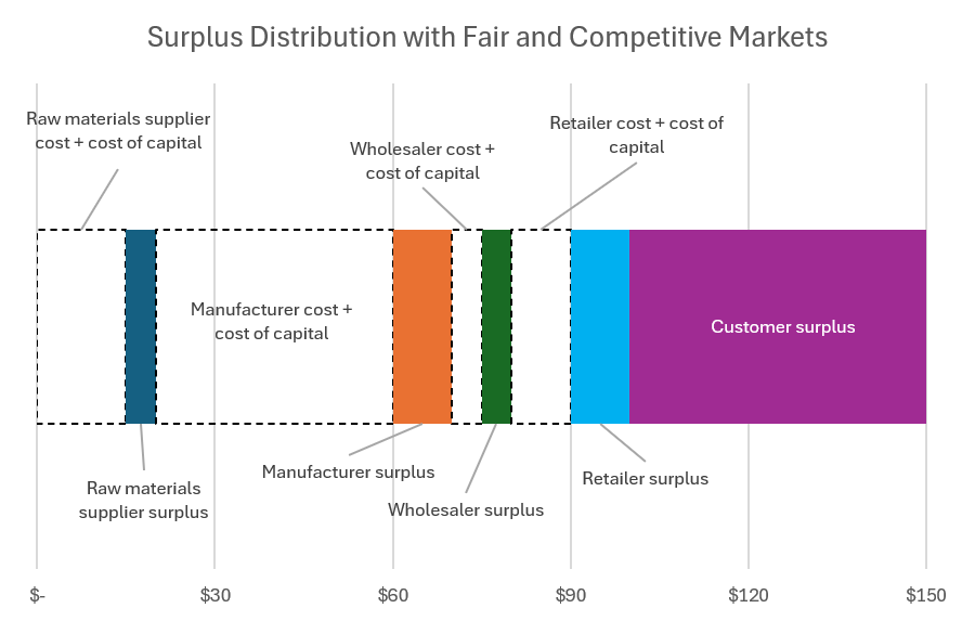
However, we haven’t identified surplus for each node just yet. Customer surplus is surplus, but the gross profit of each node doesn’t capture “surplus” (i.e. profit above subsistence levels). We need to subtract out the minimum level of profit needed for the node to stay in business rather than exiting the market. This means we need to account for not just operating expenses, but ALSO cost of capital. If a business cannot sustainably earn a return above its cost of capital, then the business will eventually shut down, even if it is profitable. For example, if a business takes up $100M of capital but only earns $2M in profits per year, it would be smarter to liquidate the business and reinvest the proceeds elsewhere that can earn higher than 2% annual return. Even if the business doesn’t liquidate immediately, it would cease investing in operations as a going concern (i.e. not maintaining or replacing existing equipment), knowing that incremental investments do not earn above its cost of capital. Eventually, the result is the same – cessation of operations. Cost of capital is the minimum hurdle of return the owners need to not exit the business by liquidation or by attrition.
Therefore, we take the gross profit, minus all operating costs to get net profit, then subtract out cost of capital to get economic profit, aka surplus. In our example, the manufacturer and the raw materials supplier are very capital intensive, so their economic profit is comparable to those of the wholesaler and the retailer. The customer captures most of the surplus, suggesting that each node is a competitive market and the value chain principally benefits the customer, who captures the bulk of the surplus.
What happens if one node substantially increased its RBP vs all other nodes? It would extract most of the surplus in the system, leaving industry stakeholders at or near subsistence. Suppose the manufacturing layer rapidly consolidated such that it became an oligopoly. It would pressure its suppliers to cut pricing and hike prices downstream; retail and wholesale would be forced to pass along the higher cost to their customers. The raw materials supplier is left at subsistence – it earns a return equal to its cost of capital, just enough to keep the business alive. Customer surplus has been squeezed from $50 to $20, having been forced to pay $30 more for the same product.
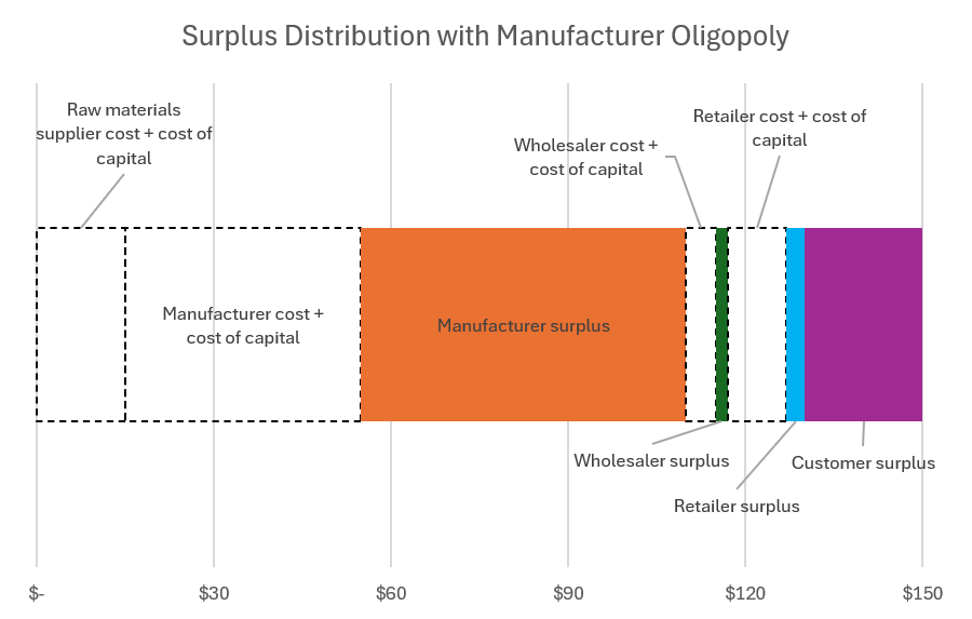
This isn’t even the full story, because each node has other counterparties like employees, non-supplier vendors like landlords, energy providers, insurance providers, etc. Each of those parties has their own surplus. The manufacturer oligopoly could plausibly exert wage pressure across the entire value chain (suppliers and customers being forced to cut pay). As discussed earlier, this is exactly what happened to the non-chaebol companies and their employees, under overwhelming pressure from their chaebol counterparties.
Pharma value chain
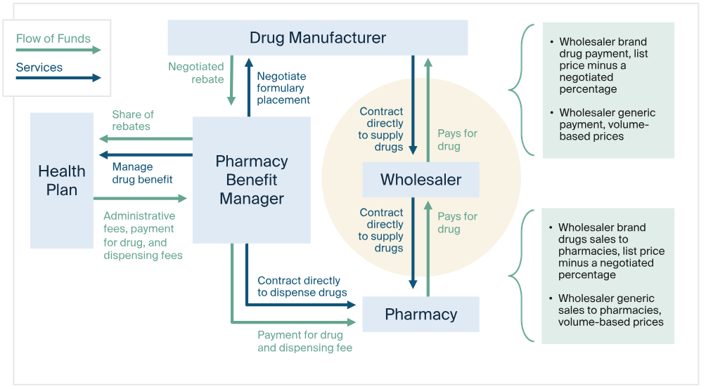
Let’s look at the US prescription drug value chain as a case study for how RBP shapes the surplus capture within a system. Drug makers sell their products to wholesalers who provide the logistics to distribute drugs to pharmacies and healthcare facilities (for provider-administered drugs, which are beyond the scope of this analysis). The pharmacy benefits managers (PBMs) specifically manage the Rx needs of the beneficiary on behalf of the payer, who’s typically the health plan. The health plan pays for the drugs or healthcare services the beneficiary needs; ultimately, the sponsor pays the health plan to manage it all.
I will skip the esoteric mechanism of the value chain and primarily focus on the relative power among the different nodes.
Pharma companies
The pharma industry is capital intensive and risky – today, drugs take a lot of time and resources to get approved. Larger pharma companies typically offload much of the risk-taking to small biotech firms funded by venture capital. Once a drug candidate nears the finish line, a large pharma company would acquire the biotech company, since much of the risk has already resolved. Large pharma companies bring their scale advantages in running clinical trials, bargaining power vs counterparties downstream, and their global distribution advantages to the drug once it is approved.
It is impossible to gatekeep drug discovery, and large, mature pharma companies compete aggressively for promising biotech companies to refill their pipelines.
Drug wholesalers
This business is primarily a scale and logistics play, whereby the wholesaler purchases drugs from pharma companies and then distribute the products to pharmacies around the country for a small markup. The wholesaler typically buys the drug at wholesale acquisition price (WAC, i.e. gross price) minus some discount.
The drug wholesale industry has undergone significant consolidation over time, from 200 in 1975 to 50 in 2000, with the top 3 wholesalers accounting for 92-95% market share today. Strict supply chain regulations and heavy DEA compliance burdens present high barriers to entry, in addition to a nationwide distribution and logistics network for handling perishable, high-value goods.
Pharmacies
Pharmacies dispense prescription medication to patients, and they’re often independently owned, part of a national chain, owned by the hospital, owned by supermarkets, integrated into long-term care, or mail-order. Barriers to entry are low, and market share is highly fragmented, with the top 15 pharmacies accounting for only 27% of total prescription revenue.
Pharmacy benefits managers (PBMs)
PBMs are like health insurers, but for prescription drugs. PBMs gatekeep the patients in the health plans that it serves, creating formularies by leveraging bargaining power. For any given type of drug, the PBMs will negotiate with the drug company for discounts (manifesting as rebates) in exchange for inclusion in the formulary, i.e. allowing that drug for selection by the patient. Drugs excluded from the formulary would face a reduction in total addressable patient population by the size of the PBM’s beneficiaries.
PBMs are purely a play on RBP. The number of patients gatekept by the PBM determines how much price concessions (rebates) they can extract from the pharma company, which determines the PBM’s value proposition to the payer. Unsurprisingly, this industry incentivizes scale, so it has consolidated over time, such that the top 3 PBMs manage 80% market share. The true market share is even more overwhelming, because the 80% doesn’t capture the fact that smaller PBMs contract out formulary management to the big 3, such that their drug purchasing volumes are aggregated behind the big 3 to maximize bargaining power.
Note that the big 3 are vertically integrated into 3 of the biggest private health plans.
Health plans
Whereas health plans care primarily about local market share as the basis of their bargaining power (since healthcare services are provided locally), PBMs care about national market share as the basis of their bargaining power. Therefore, even though health plans can be oligopolies within any local market, at the national scale, they are relatively fragmented.
Because the beneficiaries of the health plans are the source of bargaining power of the PBMs (i.e. the more health plans contract with the PBM to provide pharmacy benefits, the more patients the PBM can gatekeep in negotiations with other counterparties), bargaining power is fairly even between the two nodes. That said, massive plans like Centene that don’t have their own PBM can extract so much concessions that the PBM barely makes a margin; Express Scripts increased its beneficiary pool by 20% just because of winning the Centene account, yet they anticipated margin on the business is low. In contrast, PBMs earn their highest margin on small plans and employers.
Sponsors
Sponsors purchase medical and pharmacy benefits on behalf of their beneficiaries.
The only sponsors that directly contract with PBMs are large employers. Even then, large employers don’t have much bargaining power vs PBMs compared to health plans – besides Walmart and Amazon, no other private employer has more than 500K employees. Even a small health plan would have a few hundred thousand members, so employers aren’t on the same scale as health plans in terms of bargaining power. Medium and small employers contract with the health plan, who subcontracts with the PBM (almost always a subsidiary of the health plan).
Non-employer sponsors typically are too large to be squeezed by PBMs – like CMS and state Medicaid agencies.
Results
Note that for companies, the “subsistence” rate of return is equal to cost of capital, i.e. the return of the next best alternative (typically some benchmark) with a similar risk profile. If a company cannot sustainably earn above its cost of capital, it would shut down eventually. There’s no universally agreed-upon way to calculate cost of capital, but it is typically estimated to be between 5 and 10%; this makes sense when anchored to the historical annual return of the US equity market of ~8%. How are economic profits (profits above cost of capital) distributed across the nodes of the value chain?
- Pharma is a risky industry with a large variance in return on capital. As a result, cost of capital is higher. The estimated average return on capital of 10.3% for the pharma industry suggests the industry only earns a modest surplus on cost of capital, which is estimated to be around 8% to 8.5% for pharma and biotech companies, respectively
- There’s a bifurcation of surplus – pharma companies with massive blockbuster products under IP protection enjoy high bargaining power vs all nodes, but generic drug manufacturers earn subsistence returns
- Pharmacies sit between two layers of consolidated middlemen – the wholesalers and the PBMs. Pharmacy profitability is constantly strained, especially independent pharmacies
- Wholesalers have abused their bargaining power to extract high returns from the drug value chain, piggybacking off of WAC inflation driven historically by the PBMs (WAC inflation is nearing its end). In FY2025, the big 3 wholesalers generated ~$9.5B in operating profits from US drug wholesale operations and about 57% return on invested capital in aggregate
- In terms of incremental returns on capital, the big 3 wholesalers spent $2.0B in capital expenditure in FY2025 to support $11.1B of total operating profits (including non-wholesale operations)
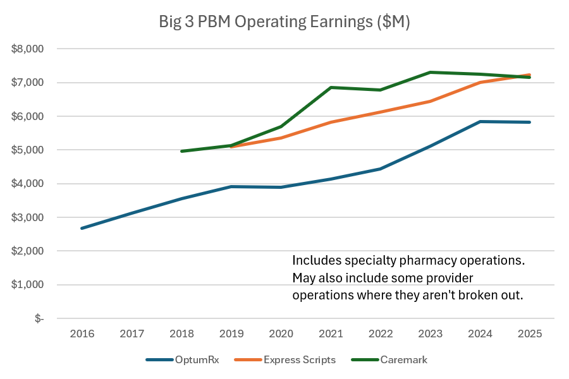
- The PBMs have also abused their bargaining power to extract surplus across the value chain, not just from the pharma companies but also from pharmacies and even patients via spread pricing (now extinct). In FY2025, the big 3 PBMs generated ~$21.6B in operating profits. PBM balance sheets are buried in consolidated financial statements, so returns cannot be estimated
- OptumRx only needed $400M of annual capital expenditure to support $7.2B of operating profits, suggesting higher return on incremental capital
- PBMs are also stronger than wholesalers because each PBM provides unique value that cannot be replicated by another PBM. Each patient is only represented by one PBM, such that if a drug maker fails to get into the formulary for a particular PBM, they lose access to those patients entirely. In contrast, wholesalers do not provide unique value
- Health plan return on capital varies, though their financial results are more a function of the power dynamics in the medical services side of healthcare rather than pharmacy
- Employer sponsors have historically been squeezed by PBMs via rebate capture, i.e. the PBMs keep a percent of the discount (rebate). The problem got bad enough that the PBMs were forced by legislation to fully pass through rebates to sponsors
Normally, wholesalers can stock up certain drugs at older, lower prices and wait until the drug maker to increase prices before selling, i.e. capitalizing on inventory appreciation. Sometimes, certain pharma companies have so much bargaining power (e.g. perhaps the pharma company owns the IP for a novel drug that sets a new standard of care) such that they can demand the wholesaler return inventory appreciation value.
The futility of trying to change distribution without changing RBP
Everybody knows that PBMs have become an abusive player in the pharmacy value chain – they extract too much surplus, manifesting in ways that have become unconscionable to the public, forcing legislative actions. The goal is obvious – how do we stop PBMs from abusing their market power to extract rent from the system?
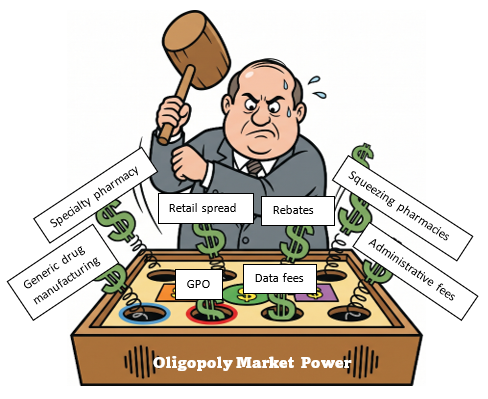
Lawmakers in Congress and in state legislatures have floated and enacted many rules and regulations over the last ~8 years aimed at curbing PBM market power abuse and extraction. But ultimately, they’re playing whac-a-mole. Each time they crack down on a particular manifestation of market power abuse (the different ways in which PBMs extract surplus), PBMs shift towards new ones. It is the same dynamic as the feudal plantation example I gave in Incumbency Theory 1.1. This is because without changing relative bargaining power, equilibrium surplus distribution cannot be changed. The big 3 PBMs’ RBP is derived from market share consolidation. Without breaking them apart, the state cannot stop them from extracting from the value chain. But that same market power is also the source of the value they provide to customers in the first place, i.e. bargaining power vs the pharmaceutical companies – a bit of a catch-22.
Solution
Because PBMs’ value-add to clients comes from their market power, breaking PBMs apart (i.e. nullifying oligopoly market power) would simply shift surplus into the pockets of the pharma companies. Drugs would become more expensive on a net basis, because the pharma companies would be dealing with weaker and less consolidated buyers. The solution is quite simple – leveraging a state-controlled monopsony for drugs (single-payer). This way, discounts can be maximized and all of the savings passed downstream by government fiat.
Tariffs and who pays them
Let’s use our RBP framework to think through who would bear the burden of the Trump tariffs enacted in 2025. As discussed earlier, we need to consider relative bargaining power through the entire value chain to predict how the surplus reduction (the tariff) would be distributed.
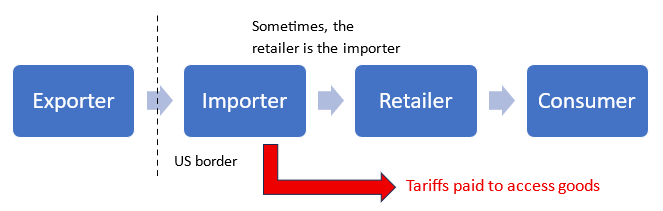
First, the importers of record, i.e. the American company that ordered the imported products, directly pays the tariff so that the imports get released from the port of entry. Next, let’s consider relative bargaining power.
- Large companies like Walmart have particularly strong bargaining power and can offload the burden more readily on counterparties like the exporters, consumers, and their vendors – the companies whose branded products appear on Walmart’s shelves. It’s very unlikely that big companies with strong market positions had to absorb any tariff burdens themselves. They could also use an obscure rule to reduce their tariff bills, which smaller companies couldn’t feasibly use due to significant documentation and transparency requirements from their overseas vendors. Additionally, the tariffs massively increased liquidity requirements for taking inventory, again straining smaller companies.
- As to the foreign vendors – their margins were never high to begin with, especially Chinese companies exporting to the US. They’ve had to deal with large buyers like Walmart for decades and probably have low margins. As a result, they have downside protection. Moreover, global vendors can simply sell their products into non-American markets – Chinese trade surplus hit new records despite the tariffs. The Federal Reserve Bank of New York estimates that the vast majority of tariffs are borne by American importers directly, who then pass it along downstream.
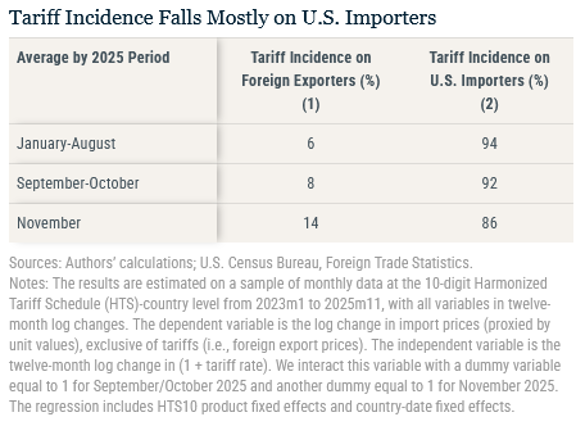
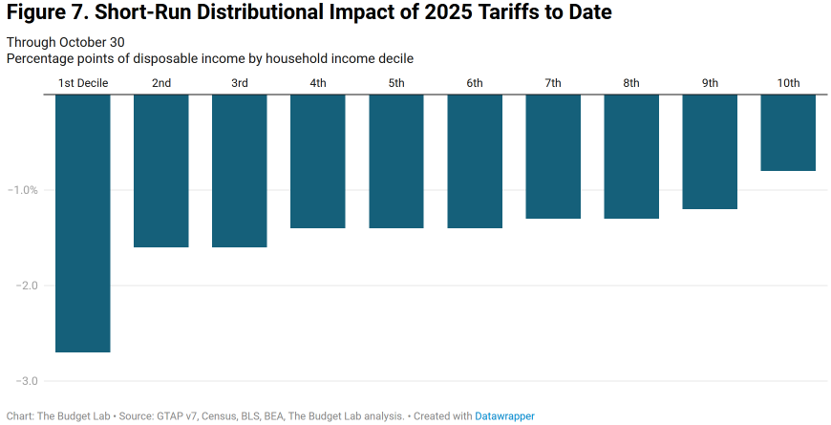
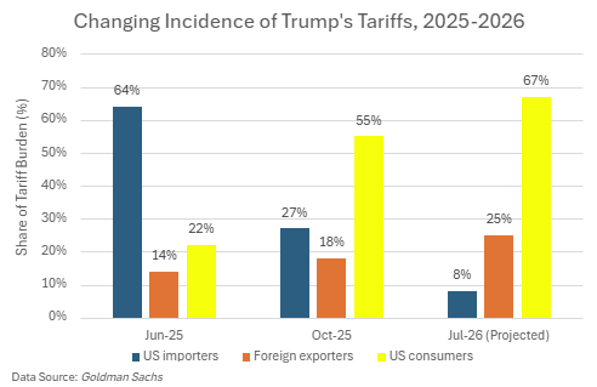
- US consumers have little bargaining power, per usual, because they do not collectively bargain and the US business environment is highly consolidated with modest competition. As a result, they will eat most of the tariff burden. Yale estimates $1,800 cost of tariffs for the average household. Goldman Sachs estimates that consumers would have eventually footed 67% of the tariffs
- Tariffs are a regressive tax that hits the lowest income consumers the most. This is because low-income consumers typically face structural bargaining power disadvantages versus counterparties due to factors like fewer stores (few alternatives), transportation hurdles (few alternatives), less bulk buying, more desperation (low reserves), etc.
- Small businesses bore a good chunk of tariffs, as they also have low bargaining power relative to the other nodes in the value chain. 2025 saw a record in small business bankruptcies.
Well… now that the Supreme Court has struck down the tariffs, forcing the Trump administration to refund them, who gets the refunds? The importers, since they were the ones who originally paid the tariffs directly to the US Treasury – this is the easiest way since the Treasury can simply reverse the payments. Consumers who paid higher prices have no standing in the process or any legal remedies besides class action lawsuits. If consumers had high bargaining power relative to companies, they could have forced concessions out of the retailers and importers.
Frequently, the importer isn’t the company selling the product, so the importer had originally passed along to their customers (companies) the cost of the tariffs. However, unlike consumers, larger companies typically have the bargaining power required to force some level of concessions out of importers when the refunds arrive. When Walmart isn’t the importer of record, it doesn’t directly receive the refund, but it would likely attempt to extract part of the refund from the importer purely out of market power.
Because Walmart raised prices and pressured suppliers to offload most of the tariffs, it only absorbed a small portion of the total tariff costs (Walmart gross margin was very stable in 2025). However, because Walmart was the importer of record for the vast majority of its products, it stood to receive $10B in tariffs, even though most of it had already been passed onto suppliers and customers. Due to the political sensitivity around inflation, especially in light of the Iran War massively increasing gasoline prices, Walmart decided to grant some price cuts using the tariff refunds as a concession to dodge potential political scrutiny, i.e. they fear the power of the state if they are too blatantly rapacious.
Why smart people aren’t rich
At this point, I hope the reader has achieved a solid understanding of how RBP works. As a test, try to answer this question: “there are many smart people (like scientists) in history who have greatly contributed to human flourishing – why weren’t they rich like Rockefeller or Crassus of Rome, who’ve contributed far less?”
Because those smart people don’t have the RBP to extract a share of the surplus they create for society. Once a scientist creates a new idea that advances human knowledge by leaps and bounds, that societal value can no longer be taken away by leverage – anybody who wants to apply that idea for commercial purposes can do so without paying any royalties to the scientist. In other words, those scientists have no means of gatekeeping the value they’ve created and thus cannot extract commensurate surplus.
Specifically for the GPS, no surplus was captured by the original inventors (presumably, they were paid a fixed salary). Only a tiny portion of the surplus is captured by the employees and contractors who maintain the system within the US Department of Defense (~$2B per year). A good portion of the surplus is captured by companies that leverage GPS technology as part of their value proposition. However, the global public captures the vast majority of surplus created by GPS – nobody downstream can sufficiently gatekeep access to the technology. While the US taxpayer does not directly capture any of the surplus on the funding side (due to lack of any licensing fees), they enjoy the surplus on the user side.
Wrapping it up
In this article, I identified the flaws of normative economic theory as well as modern liberal economic orthodoxy through the lens of relative bargaining power. Both Marxist and neoclassical economic theories bring normative interpretations of price. As a result, both fail to see the bigger picture and appreciate that RBP is the only determinant of surplus. Specifically for liberal capitalism – because the ideology is so loath to “interfere” in the mechanisms of the market, western policymakers futilely attempt to change surplus distribution without fundamentally altering RBP within the economy.
Moreover, I expanded the scope of RBP beyond a simple two-party negotiation into a full value chain, whereby RBP among the various parties determines the distribution of surplus therein. And similar to my two prior articles on RBP, I argue that one cannot change surplus distribution without changing underlying RBP among counterparties.
I hope that this first part of my Incumbency Theory will serve as the foundation for understanding the rest to come. Now that I have identified the source of the power of the elites, my next article will define just who these incumbents are and how to find them. Without the RBP framework, one cannot hope to accurately identify the incumbent elites within society.
- This is an interpretation inherently rooted in the material reality of Marx’s time, because back then, most people in industrialized Europe worked in factories, i.e. the “means of production.” Today, the US has no industrial base, so there isn’t much “means of production” to seize, since they are in China. Instead, powerful American corporations capture surplus by creating economic tollbooths ↩︎
- The wealth disparity between the elites and the poor in the USSR naturally wasn’t as extreme as in capitalist countries, but that level of central control impoverished all ↩︎
- Some unions face the same problem with their leaders living lavish lives of privilege, more interested in maintaining their comfortable positions than working on behalf of their membership constituency ↩︎
- FDR believed that while private sector unions and their employers can bargain it out, public sector unions are negotiating with the state, which represents the will of the people. A union (or in theory, any private interests) must never exercise significant leverage over the state and thus the nation, which could paralyze critical functions of the state. ↩︎
- The liberal conceptualization of consent manifests in theories about the consent of the governed, social contract, etc. ↩︎
- Section 8 was part of the Housing Act of 1937. The main provision was for the creation of public housing built by the state. Instead of fully embracing the prerogative of providing abundant housing for the people, the federal government conceded to only replacing existing unsafe/unsanitary units with new units rather than adding net new units to the housing stock. This was intended to prevent competition with the private market of landlords. Unsurprisingly, the state was handcuffed from threatening the RBP of landlords. ↩︎